 |
Mogao Cave 17: Mulasarvastivada Commentary
|
| |
|
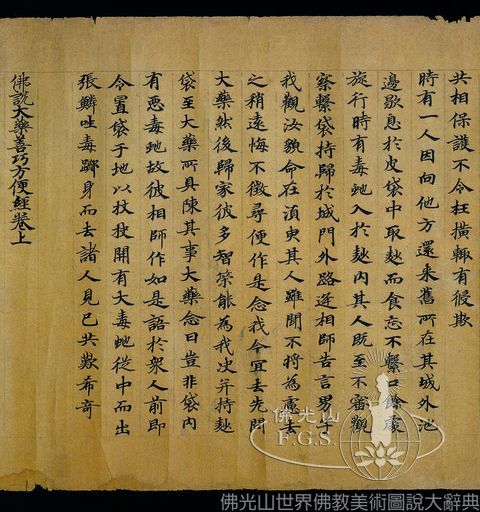
Mogao Cave 17: Mulasarvastivada Commentary
CHINA, Gansu, Dunhuang; Tang dynasty (618–907); Regular script; Handscroll; Ink on bark paper; 25.1 x 158.4 cm; Dunhuang Research Academy, Gansu, China
This sutra manuscript was discovered in 1899 in Mogao Cave 17 in Dunhuang. The beginning of the scroll is missing, but the remainder is still intact. There are a total of 80 lines consisting of 17 characters each. Prior to the Tang dynasty (618-907), this sutra was not widely circulated. Excerpts from the Tang dynasty compilation, Catalog of the Kaiyuan Era on Buddhism, describe the sutra as one that explains the Mulasarvastivada Vinaya-Vastu. It was not until the period of rule under Emperor Gaozong (reigned 649-683) and Empress Wu Zetian (reigned 690-705) that this sutra became an independently circulated scripture.
This scroll is written in regular script and ruled with black column guidelines. Most characters commence with a sharp edge, perhaps due to the swift brushwork that results in pointed tip landings. Successive characters appear to have strokes that show signs of implicit links. Despite the speed, there is a strict composition, complete with vigorous brushwork and an interesting range of stroke variety. |