 |
Xingjiao Temple Main Hall: Life of the Buddha - Defeat of Mara and Enlightenment
|
| |
 |
Xingjiao Temple Main Hall: Life of the Buddha - Defeat of Mara and Enlightenment
|
| |
|
Xingjiao Temple Main Hall: Life of the Buddha - Defeat of Mara and Enlightenment
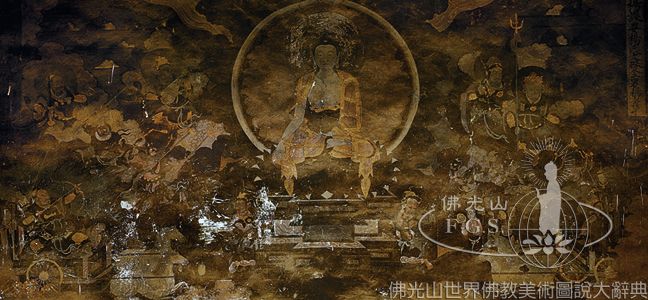
CHINA, Yunnan, Jianchuan; Ming dynasty (1368–1644); Commissioned by Yang Hu; 148 x 288 cm
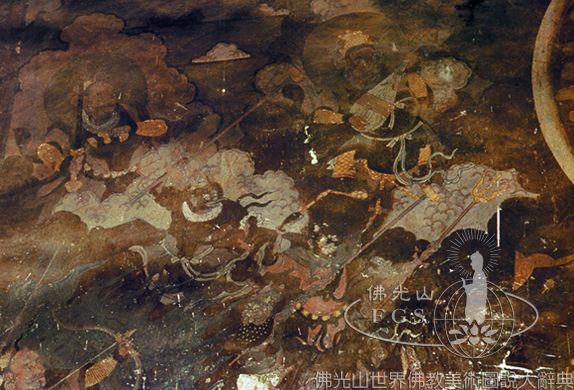
Xingjiao Temple was built in 1415 during the Ming dynasty in a style typical of the Vajrayana Buddhist temples in the Yunnan region. The walls were decorated with 32 murals inspired by the Long Scroll of Buddhist Images painted by Zhang Shengwen during the Dali Kingdom (937-1253). This scene, painted on the upper arch of the central bay of the entrance to the main hall, is one of the best preserved of the 11 murals that still remain.
Sakyamuni Buddha sits on a lotus throne in the center of the mural, reaching down with the right hand to form the bhumisparsa (earth-touching) mudra. The Buddha wears a gold-striped monastic robe, has a dark nimbus, and is surrounded by a mandorla with a white border. The Four Heavenly Kings, wearing golden crowns and armor, stand beside him. Two Dharma protectors lift up the pedestal that supports the lotus throne. Below, an army of animal-headed demons charges towards the Buddha, desperately trying to prevent him from attaining enlightenment. A bearded man riding in a chariot in the lower left corner draws a bow. Another chariot carrying an elegant female figure is depicted in the lower right corner. Clouds fill the background. In the upper left corner, an inscription within a cartouche reads Homage to the Assembly of Sakyamuni Buddha's Defeat of Mara." A second inscription in the upper right corner states that this mural was sponsored by the family of Yang Hu and lists their names. "Manjusri" is included as part of the list. This reflects a custom in Dali whereby the names of Bodhisattvas are added to lists of the sponsors of a Buddhist artwork as a show of devotion." |