 |
Mogao Cave 148: Illustration of the Mahaparinirvana Sutra
|
| |
|
Mogao Cave 148: Illustration of the Mahaparinirvana Sutra
CHINA, Gansu, Dunhuang; Tang dynasty (618–907)
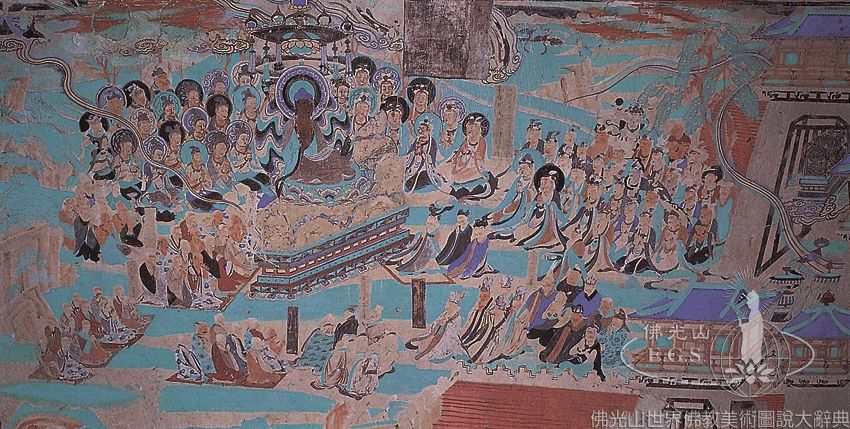
This illustration of the Mahaparinirvana Sutra is located behind the reclining Buddha statue on the back (west) wall of the main chamber, and extends onto parts of the north and south walls. It dates from the High Tang period (712–756). The mural contains 66 scenes arranged sequentially from left to right and grouped into ten sections. Each scene is accompanied by an inscription, some of which are still legible. The scene of the Buddha’s Last Teaching, given in the city of Kushinagar, is on the right side of the south wall. The Buddha is shown surrounded by disciples and Bodhisattvas. An inscription below reads “Introductory Chapter of the Mahaparinirvana Sutra.”
The majority of the scenes are painted on the back wall. In the scene of Cunda’s Last Offering, the Buddha accepts his final meal from Cunda while numerous beings stand alongside, including layman, laywomen, the King and Queen of Vaishali, other kings and queens, naga king, and garuda king, their food offerings having been refused. In the portrayal of Parinirvana, the Buddha lies on his side beneath the twin sala trees while his mother Queen Maya, disciples, Bodhisattvas, the Eight Classes of Dharma Protectors, and the Buddhas of the Ten Directions gather at his side. Similarly, in the scene of Mourning over the Casket, disciples, Bodhisattvas, and Queen Maya are seen in attendance. In the image of the Buddha Emerging from the Casket, Sakyamuni is shown sitting in lotus position on a lotus throne atop his casket as he expounds the Dharma to his mother. In the next scene of the Casket Rising by Itself, the casket rises into the air and circles the city of Kushinagar seven times. In the portrayal of the Funeral Procession, six warriors act as pallbearers while the Buddha’s disciples and the people of Kushinagar follow behind. The Cremation scene illustrates the futile attempts of two figures trying to light the pyre, and the golden casket bursting into flames on its own, ignited by the body of the Buddha within. To the left are heavenly beings, who extinguish the fire with rainwater poured from their bejeweled jars. Surrounding the casket are Bodhisattvas, disciples, heavenly beings, and laypeople in mourning.
Two scenes are painted on the left side of the north wall: the Distribution of Relics Among the Eight Kings and the Construction of Stupas. In the first scene, two laymen distribute the Buddha’s relics to eight kings, with heavenly beings, disciples, and laypeople in attendance. In the second scene, monastics and laity kneel in reverence before a single story stupa that houses a decorated reliquary. |