|
Mogao Cave 17:Manjusri Bodhisattva at Wutaishan
|
| |
 |
Mogao Cave 17:Manjusri Bodhisattva at Wutaishan
|
| |
 |
Mogao Cave 17:Manjusri Bodhisattva at Wutaishan
|
| |
 |
Mogao Cave 17:Manjusri Bodhisattva at Wutaishan
|
| |
 |
Mogao Cave 17:Manjusri Bodhisattva at Wutaishan
|
| |
 |
Mogao Cave 17:Manjusri Bodhisattva at Wutaishan
|
| |
 |
Mogao Cave 17:Manjusri Bodhisattva at Wutaishan
|
| |
 |
Mogao Cave 17:Manjusri Bodhisattva at Wutaishan
|
| |
|
Mogao Cave 17:Manjusri Bodhisattva at Wutaishan
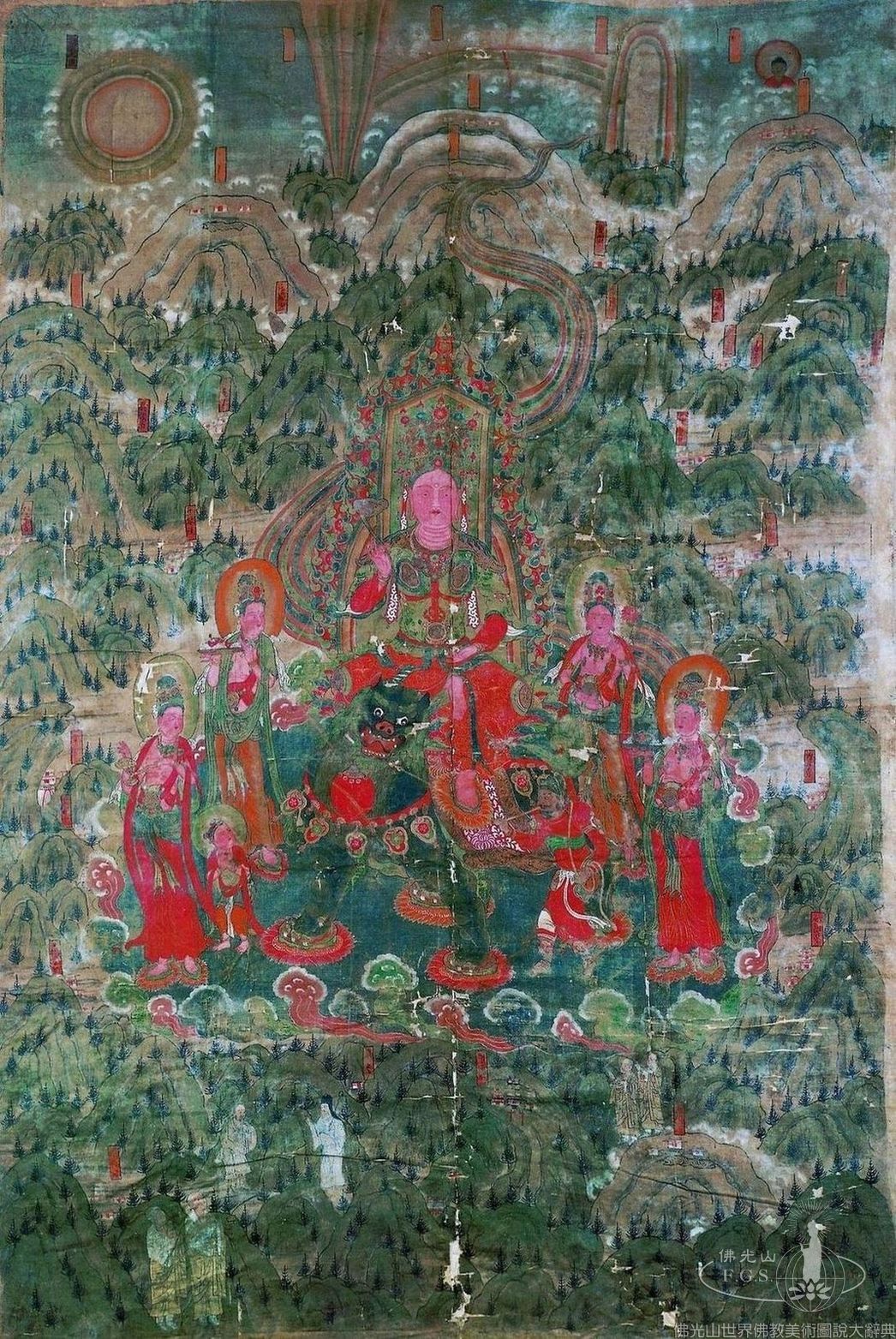
CHINA, Gansu, Dunhuang; Northern Song dynasty (960–1127); Ink and color on silk; 164 x 107.5 cm; Guimet Museum of Asian Art, Paris, France
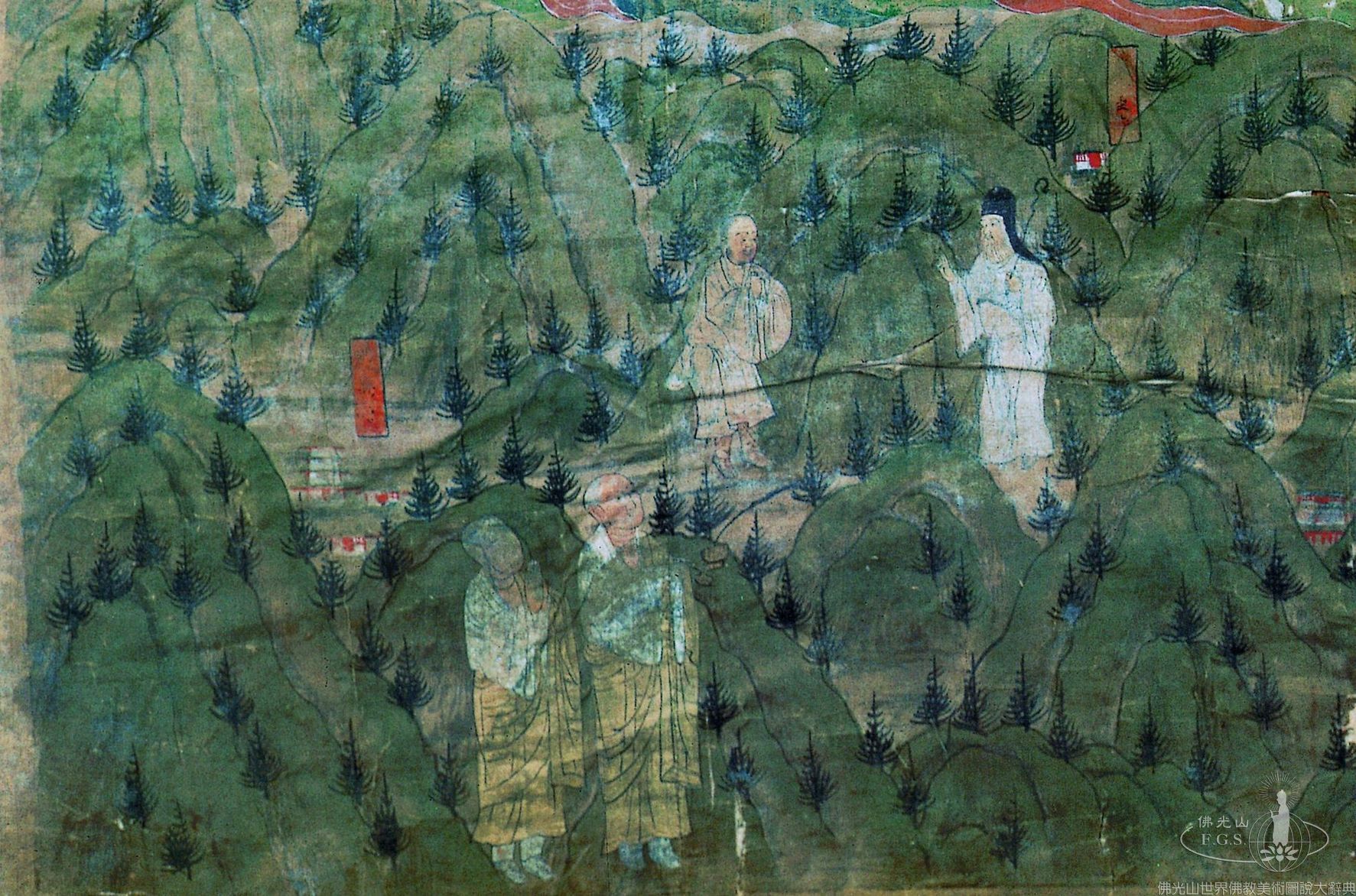
Painted on three joined pieces of silk, this well preserved, colorful work was brought from Mogao Cave 17 to France by Paul Pelliot. It shows Manjusri Bodhisattva and his attendants appearing at Wutaishan (Five Plateau Mountain) in China, marks important locations in the region, and symbolically depicts the transmission of the Usnisavijaya Dharani Sutra to China, a pivotal event in Chinese Buddhism. In 676 of the Tang dynasty, the monk Buddhapala from Kashmir, India, journeyed to Wutaishan to pay homage to Manjusri. He met an old man who asked him if he could bring the Usnisavijaya Dharani Sutra to the east to help educate the people of China. The mysterious old man vanished after making his request. Buddhapala subsequently brought the sutra from India to Chang'an (present day Xi'an, Shaanxi), and was commissioned by the emperor to carry out its translation.
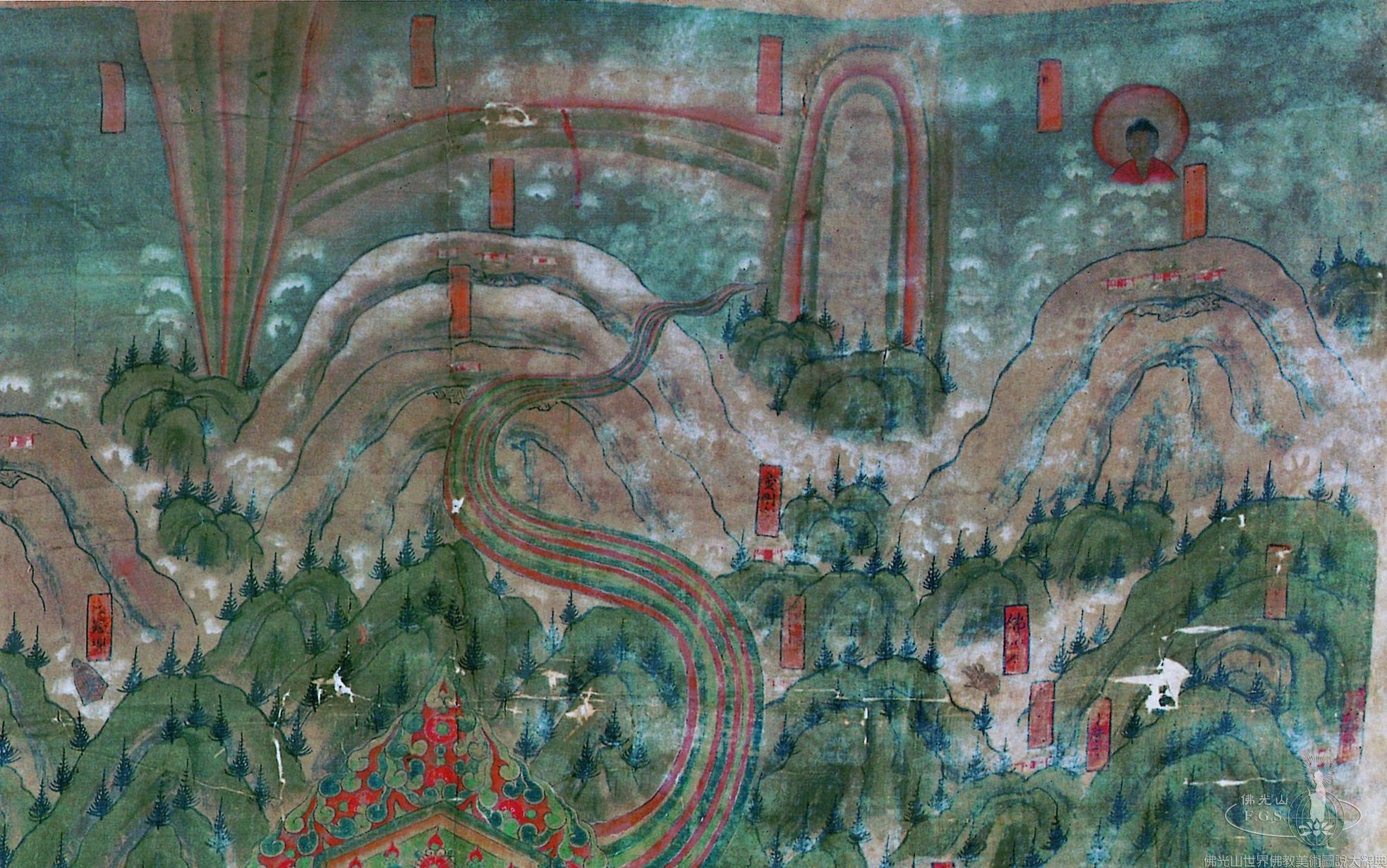
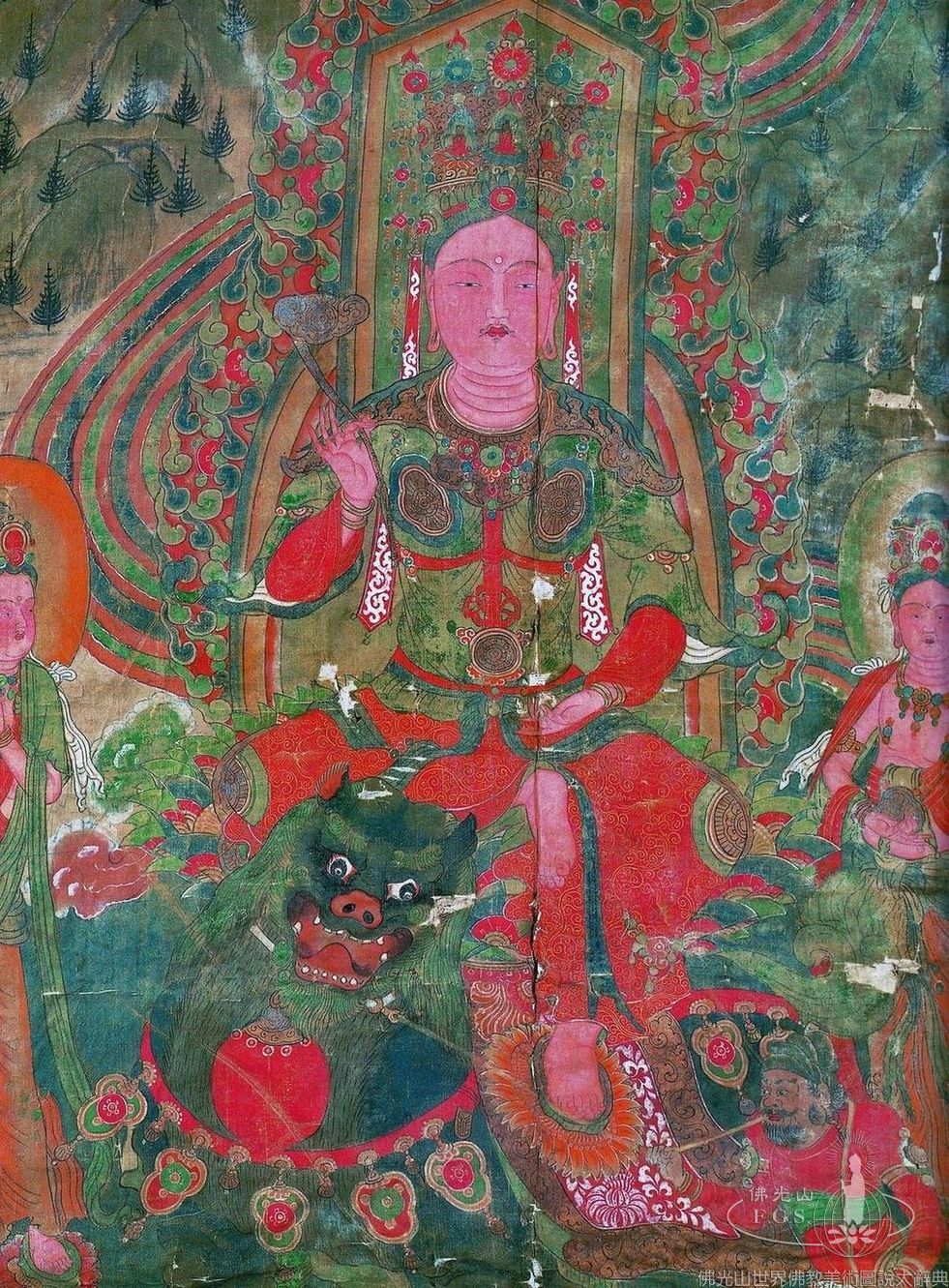
The central figure, Manjusri Bodhisattva, wears a crown decorated with three Buddha images. Intricate flame patterns decorate the outer circumference of the nimbus and aureole. The upturned left palm is placed in front of the chest, while the right hand holds a golden ruyi (wish-fulfilling talisman). A red inner garment and a green breastplate cover the upper body. With the right leg tucked against the body and the left foot resting on a lotus pedestal, the Bodhisattva sits upon a lotus throne on the back of a lion. The fierce lion stands on lotus pedestals. Its body is colored in dark blue and its mane is washed in green. A lion keeper crouches on the right, holding a thin leash attached to the neck of the lion. Manjusri is accompanied by Sudhana and four attendant Bodhisattvas. Sudhana, on the left beside the lion, joins his palms and gazes reverently at Manjusri. The attendant Bodhisattvas have slender builds and stand in tribhanga posture. They wear stoles and hold objects including flower baskets, incense burners, and lotus flowers. A trail of clouds extends off into the distance above the figures, suggesting that they have arrived from far away.
Many hills dotted with small trees fill the rest of the painting. In the upper register, there are three large brown peaks labeled with worn out inscriptions. The peak on the left side is the south plateau, and is depicted with the small Naga King Lake at the top. The peak on the right side is the east plateau, and it has Anavatapta Lake at the top. According to the Old Account of Wutaishan, the sacred footsteps of Sakyamuni, Manjusri, and Samantabhadra can be found on these three peaks. The brown peak at the bottom of the illustration is also one of the five plateaus of Wutaishan. The south plateau has an inscription that reads Conversation Stone |