 |
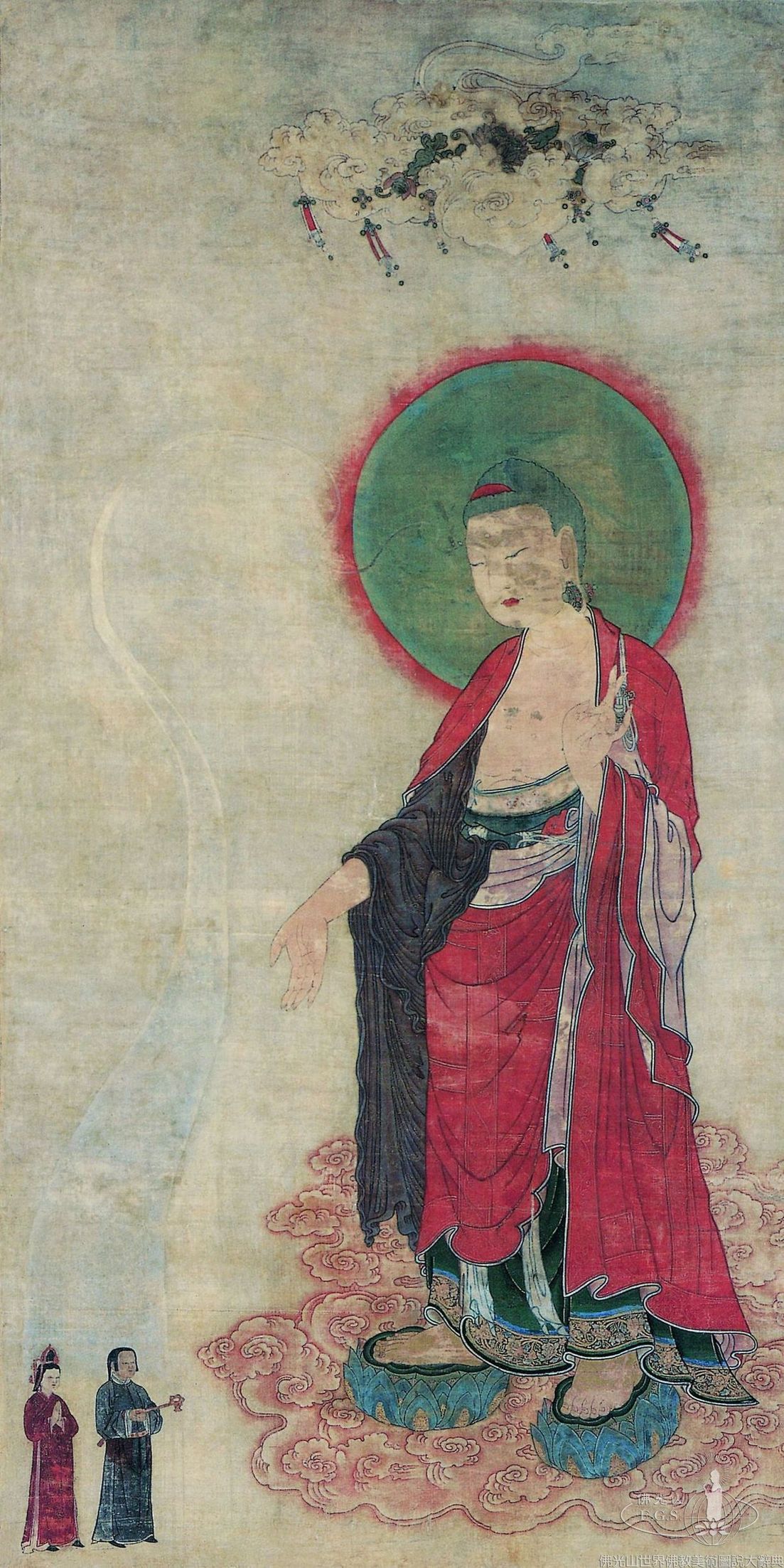
Khara Khoto: Amitabha Buddha Welcoming the Deceased
|
| |
|
Khara Khoto: Amitabha Buddha Welcoming the Deceased
CHINA, Inner Mongolia, Alxa; Western Xia period (1032–1227); Ink and color on silk; 125 x 64 cm; State Hermitage Museum, St. Petersburg, Russia
This painting from the first half of the 12th century was discovered in Khara Khoto. Amitabha Buddha, wearing a red monastic robe painted with delicate folds, stands on two lotuses that float on clouds. Floral patterns drawn with gold paint can be seen on the bottom hem of the Buddha's inner robe. The right hand is held out, forming the welcoming mudra. The Buddha has narrow eyes, small lips, and a green nimbus with a red aura surrounding it. There is a distinctive shell-shaped earring in the Buddha's left ear. A white cloud with hanging tassels is painted above the Buddha.
Amitabha's urna emits a trail of white light that flows down to a deceased couple in the bottom left corner, which guides them to the Pure Land. The man holds a long-handled incense burner. He has the bare forehead hairstyle popularized during the Western Xia period (1032-1227) by Emperor Jingzong (reigned 1032-1048). The woman has a high topknot, and joins her palms together. Based on their appearance, the couple were likely members of the nobility. A sense of tranquility permeates the image. The painting style is skillful and succinct, showing the influence of Song dynasty (960-1279) artworks. |