 |
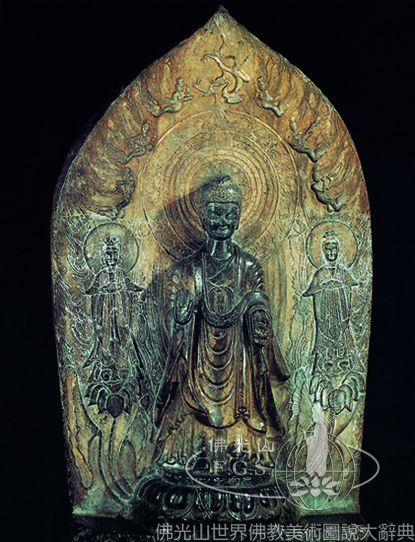
Maitreya Buddha and Attendants
|
| |
|
Maitreya Buddha and Attendants
CHINA; Eastern Wei dynasty (534–550), dated 535; Commissioned by Zhang Bainu; Limestone; Yurinkan Museum, Kyoto, Japan
Maitreya stands on an inverted lotus pedestal with his hands in abhaya (fearlessness) and varada (wish-granting) mudras. The figure wears a monastic robe that is opened at the front, with large folds spilling downwards and hems that spread outwards.
The mandorla is mostly carved in bas-relief and features attendant Bodhisattvas standing on outgrowths from the pedestal and making offerings. Apsaras fly about the outer rim and there is a water-spouting dragon at the apex. The mandorla also encompasses the Buddha’s nimbus and shallower aureole. The nimbus consists of a lotus at the center surrounded by concentric circles and finally a thicker circle filled with filigree.
An inscription found on the front states that the artwork was commissioned by several people including Zhang Bainu and Zhang Ningyuan in 535. The statue was listed as an Important Cultural Property of Japan in 1960. |