 |
Manjusri Bodhisattva
|
| |
|
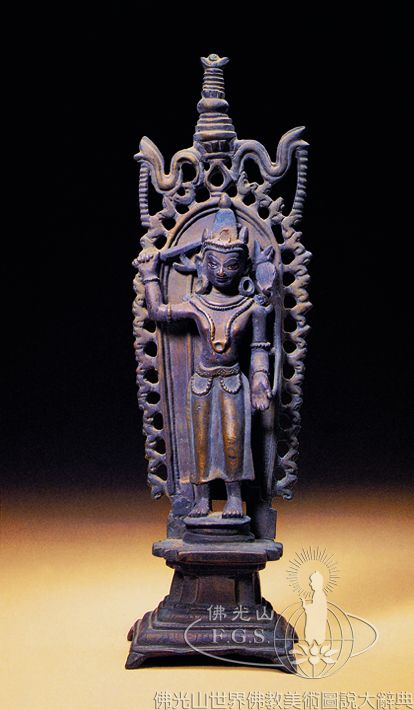
Manjusri Bodhisattva
CHINA; 11th–12th century; Brass; H: 22.5 cm; Palace Museum, Beijing, China
The statue dates from a time when Tibetan art was influenced by the sculptural style of the late Pala period (circa 8th–12th century). Manjusri wears a crown about a conical usnisa surmounted by a gemstone. The Bodhisattva’s right hand brandishes the sword of discernment while the left opens in varada (wish-granting) mudra. Rising from behind the hand to shoulder height is a long-stemmed lotus. The Bodhisattva is adorned with large circular earrings as well as jewelry on the arms and chest, and stands on a raised pedestal with the left foot slightly advanced. A narrow petal-shaped mandorla with a budded rim rises to an ornate stupa whose double-staged spire is supported by lotuses and rises to a crescent moon top-piece. Serpentine banners support the stupa at the base. The pedestal is a simplified version of the many-cornered Bengali style from the Pala period and is attached to a slightly curved Sumeru base. |