 |
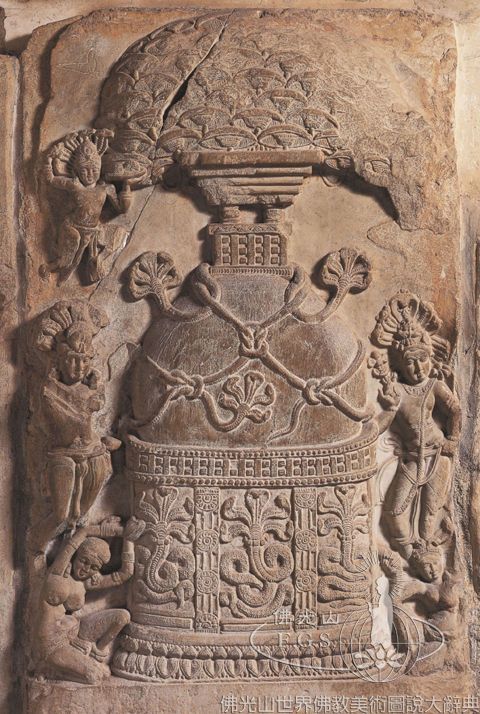
Amaravati: Naga Kings Protecting a Stupa
|
| |
|
Amaravati: Naga Kings Protecting a Stupa
INDIA, Andhra Pradesh, Amaravati; Satavahana period (circa 200 BCE–250 CE), circa 2nd century; Limestone; H: 114.5 cm; Government Museum, Chennai, Tamil Nadu, India
While a large number of reliefs depicting the great stupa at Amaravati were discovered around its base and body, the stupa depicted here is simple in appearance and has no railing. What makes it special are the multi-headed nagas that cling to almost the entire surface. Nagas were revered in India, especially in the southern regions, so it was only natural to accept them into the pantheon of deities associated with the Buddha.
The surface of the base is divided into three bays that are occupied by five-headed nagas. The dome of the stupa is also entwined with three nagas whose bodies are knotted together. A few rectangular slabs are mounted on top of the harmika at the stupa's apex. These in turn support a large collection of parasols that form a canopy. The nagas stand on either side of the stupa, upheld by kneeling female deities. Above them hovers a young naga holding an offering. There was once an identical figure on the other side that has been worn away. The relief was likely created during the height of the Satavahana period (circa 200 BCE-250 CE). |