 |
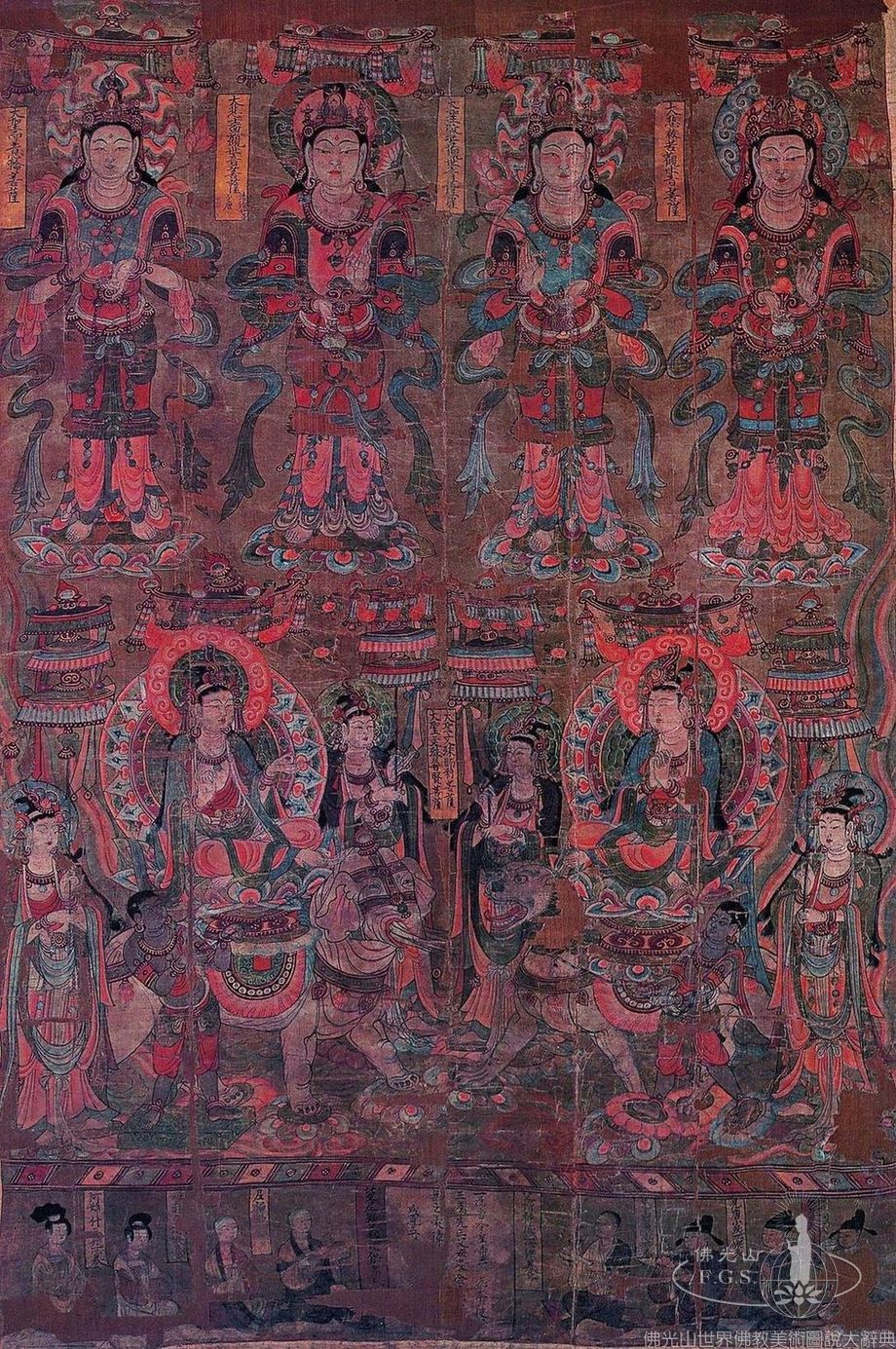
Mogao Cave 17: Manjusri, Samantabhadra, and Four Avalokitesvara Bodhisattvas
|
| |
|
Mogao Cave 17: Manjusri, Samantabhadra, and Four Avalokitesvara Bodhisattvas
CHINA, Gansu, Dunhuang; Tang dynasty (618–907), dated 864; Ink and color on silk; 140.7 x 97 cm; British Museum, London, United Kingdom
The figures in this painting are arranged in three registers. Four depictions of Avalokitesvara Bodhisattva occupy the upper register. They stand on lotus pedestals and wear headdresses adorned with Buddha images. A canopy hangs above the nimbus of each Bodhisattva. They wear Indian-style ornaments and are dressed in Chinese garments. Though their appearances are similar, cartouche inscriptions identify them as four different manifestations of the Bodhisattva.
In the middle register, Samantabhadra sits on the back of a six-tusked white elephant, and Manjusri rides a lion. They are each flanked by two attendants and are dressed in similar attire. A mahout and a lion keeper lead the elephant and the lion on leashes.
At the bottom of the picture, a monk and three male devotees kneel on the right. Two nuns and two female devotees are shown on the left. The women wear combs in their hair, which were replaced by hairpins in later paintings of this type. The inscription in the center dates the painting to 864. |