|
Lotus Sutra Commentary - Fascicle 6
|
| |
 |
Lotus Sutra Commentary - Fascicle 6
|
| |
 |
Lotus Sutra Commentary - Fascicle 6
|
| |
|
Lotus Sutra Commentary - Fascicle 6
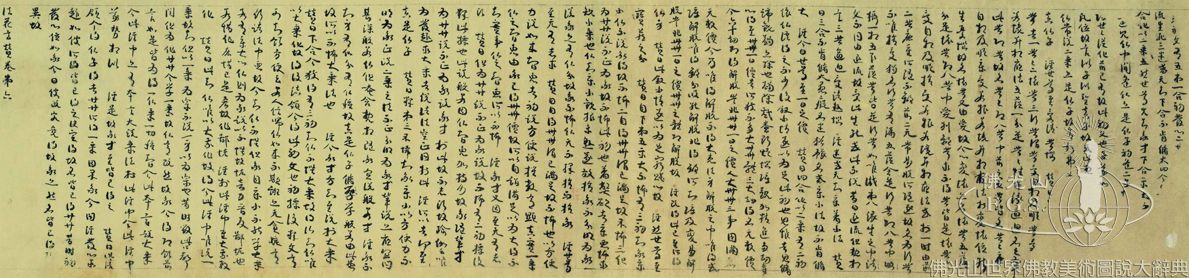
CHINA; Tang dynasty (618–907); Cursive script; Handscroll; Ink on paper; 27.2 x 116 cm; Shanghai Museum, China
Analysis and Appreciation of the Lotus Sutra is a commentary on the Lotus Sutra through the perspective of the Faxiang school of Buddhism. It is a work of concerted effort by Master Kuiji, a Tang dynasty (618-907) monk, and illustrates the level of devotion and depth of interest that the Lotus Sutra garnered at the time.
The manuscript is written in cursive script and stands out among the neat and prim sutra copying styles traditionally seen during the Tang dynasty. The use of cursive script for sutra calligraphy is not burdened by the typical standards of orderly presentation, and this particular work is observably similar to Huaisu's Thousand Character Classic in Cursive Script, where each small character is disparately written with a sense of stoic equanimity. The stylistic similarity was remarked by Dong Qichang as a form of simplicity that whitewashes the ostentatious habits of Tang writings." Furthermore |