 |
Kizil Cave 13: Vairocana Buddha
|
| |
|
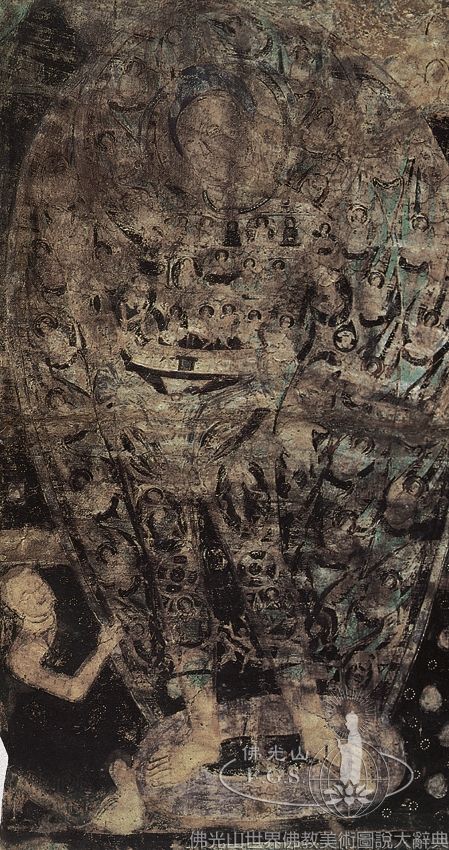
Kizil Cave 13: Vairocana Buddha
CHINA, Xinjiang, Aksu; circa 4th–late 5th century; 1.7 x 1.0 m; Museum of Asian Art, Berlin, Germany
This depiction of Vairocana Buddha was originally located on the wall outside the corridor. Within the nimbus are eight small seated Buddhas, and the inner and outer layers of the mandorla are decorated with additional seated Buddhas. Vairocana is clad in a thin robe covering both shoulders. Three rows of small seated Buddhas are painted on the front of the robe over the chest, with the wide belt tied at the waist. Three seated Buddhas are painted about the waist and on each leg, and a wheel is painted on each knee. Two figures, raising their arms, are visible between the shins. A monk kneeling on one knee is seen on the bottom left.
The Buddha’s robes represent the five realms of existence. The upper section symbolizes existence in the heavenly realms, the wheels on the knees symbolize the human and animal realms, and the thin, small figures symbolize the hungry ghost and hell realms. The style of the tilting body and the seated Buddhas in the mandorla are similar to those seen at Khotan. |