 |
Buddha and Attendants
|
| |
|
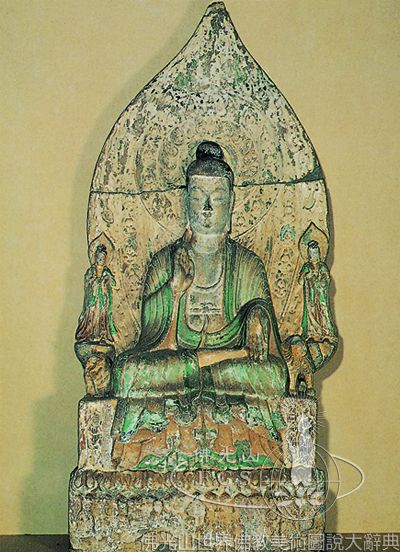
Buddha and Attendants
CHINA; Northern Wei dynasty (386–534), dated 513; Commissioned by 100 Villagers; Limestone; H: 152 cm; Kosetsu Museum of Art, Kobe, Japan
The Buddha sits in full lotus position and likely forms the abhaya (fearlessness) and varada (wish-granting) mudras. The figure has an elongated face and a thick neck. A monastic robe covers both shoulders. The folds of the garment cascading down the front of the seat. The two attendant Bodhisattvas are smaller and each is paired with a Dharma protecting lion below their pedestal.
The yellow and green paint on the robes of the figures is still bright, but most of the mandorla has faded with only a trace of the nimbus visible. The front of the base has carvings of donors but they have also worn away. An inscription dates the sculpture to 513, and states that a hundred people participated in its creation. |