 |
Five Dhyani Buddhas
|
| |
|
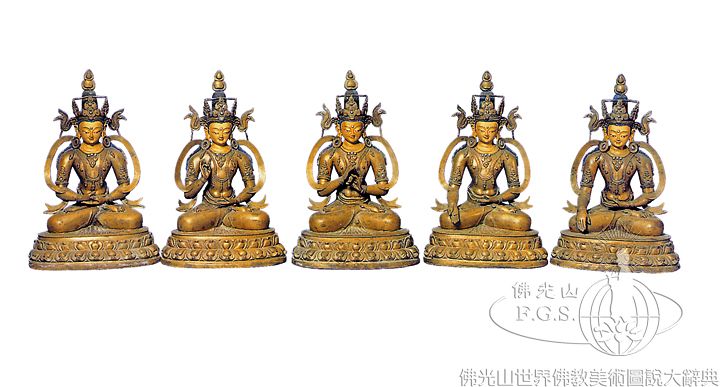
Five Dhyani Buddhas
CHINA; Yuan dynasty (1271–1368); Brass; H: 47 cm; Palace Museum, Beijing, China
The Five Dhyani Buddhas belong iconographically to Vajrayana Buddhism. All wear trefoil crowns connected by a slim chain, an element of Tibetan figures prior to the 15th century. The figures represent, from the right, Aksobhya in bhumisparsa (earth-touching) mudra; Ratnasambhava in varada (wish-granting) mudra; Vairocana in bodhyangi (wisdom fist) mudra; Amoghasiddhi in karana (warding off evil) mudra; and Amitabha in dhyana (meditation) mudra. They wear rich jewelry and stylized floating stoles frame their bodies. All figures are seated in full lotus positions on double lotus thrones.
Sculpted in the Kashmiri style, the Buddhas having broad shoulders, slim waists, and powerful arms. Vairocana's mudra, which replaces the more usual Dharmacakra (Dharma wheel) mudra, seems to indicate that the group represents the five Buddhas of the Diamond Realm, which is borne out by the silken inscriptions accompanying the other statues. |