 |
Mogao Cave 17: Mahaprajnaparamita Sastra - Fascicle 90
|
| |
|
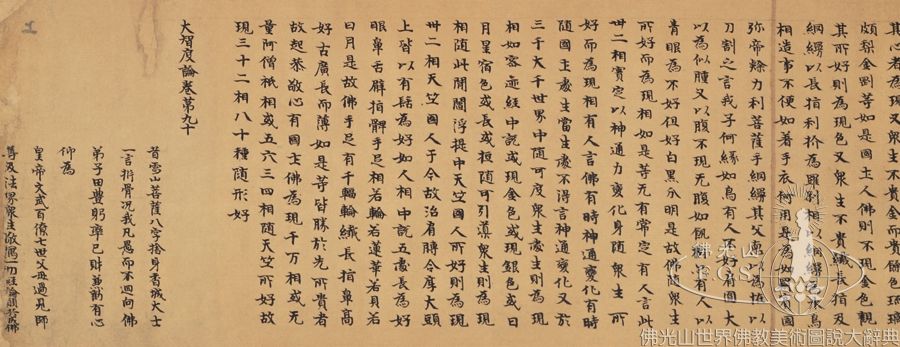
Mogao Cave 17: Mahaprajnaparamita Sastra - Fascicle 90
CHINA, Gansu, Dunhuang; Northern Dynasties (386–581); By Tian Feng; Regular script; Handscroll; Ink on hemp paper; 23.4 x 1,005 cm; Zhejiang Provincial Museum, Hangzhou, China
This scroll was discovered in Mogao Cave 17 in Dunhuang. It contains the Mahaprajnaparamita Sastra, transcribed by Tian Feng, who dedicated his calligraphic efforts to the enlightenment of all sentient beings. It was previously collected by Chen Jikan, who annotated at the start of the scroll a record of its background in a short essay entitled Record of Dunhuang Cave Scriptures using cursive script. The Mahaprajnaparamita Sastra was originally written by Nagarjuna of India. It advocates wisdom as a basis of reality underlying all phenomena. As an important Mahayana classic, the Mahaprajnaparamita Sastra explains the Bodhisattva path, the six paramitas, as well as other key practices.
The calligraphy is characterized by several expressions; these include unsteady arcs, wide berth between pressing and lifting the brush, and short, stumpy strokes that render a sense of abruptness. A dominant geometric quality pervades the work in a visually appealing way, which helps make this scroll a distinguished calligraphic manuscript. |