 |
Zarchinka Monastery: Damcho Pekar
|
| |
|
Zarchinka Monastery: Damcho Pekar
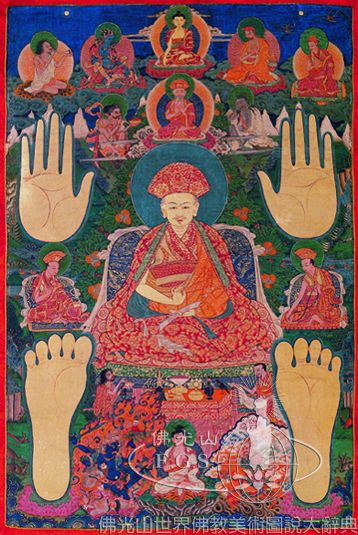
BHUTAN, Paro; 17th–18th century; Ink and color on cotton; 145 x 80 cm; Zarchinka Lhakhang, Paro, Bhutan
This thangka is kept in Zarchinka Monastery in Paro, Bhutan. Footprints were commonly used to represent the Buddha in early aniconic Buddhist art. In Tibetan Buddhism, one regards one's guru as a living Buddha, so to pay homage to the footprints and handprints of the guru is equivalent to worshipping the Buddha himself. Both the Kagyu and Gelug schools of Tibetan Buddhism have a tradition of depicting gurus' footprints and handprints in their thangkas, some created during the lifetime of the guru by means of tracing. Footprints began to appear during the 12th century, while handprints were seen by the 16th century.
The main figure in this thangka, Damcho Pekar, the fourth National Master, wears a red hat, a monastic robe, and a stole. He sits on a cushion, forming a mudra with the slightly raised right hand and holding a sutra with the left. The large hand and footprints arranged around him are outlined in dense blue lines to create contrast. The National Master is flanked by two disciples. The one on the left holds a vase while the disciple on the right holds a long string of prayer beads. A bell, a vajra pestle, a cup on a stand, a flask of sacred substances, a ritual vase, and a raven are placed on an altar below the central figure. The figures on either side of the altar hold a white ceremonial scarf and a skull cup respectively.
Sakyamuni Buddha sits in the center of the upper register. The other figures are, from left to right, a mahasiddha blowing a thighbone trumpet, Tara, an Indian master, and a monk. Directly below Sakyamuni is Shabdrung Ngawang Namgyal (reigned 1629-1651), the unifier of Bhutan. On the left, a mahasiddha sits with legs crossed, holding a dish of offerings. On the right is the thin, dark-skinned Milarepa. Ngawang Samten, a student of Damcho Pekar, sits in the center of the lower register.
On the right is Palden Lhamo, riding a horse and enveloped by colored clouds. A wrathful Dharma protector is depicted on the left. Mountains with snow-covered peaks, birds, deer, flowers, and red blossoms are painted in the background. |