 |
Wat Suwannaram Ordination Hall: Life of the Buddha - Defeat of Mara and Enlightenment
|
| |
 |
Wat Suwannaram Ordination Hall: Life of the Buddha - Defeat of Mara and Enlightenment
|
| |
|
Wat Suwannaram Ordination Hall: Life of the Buddha - Defeat of Mara and Enlightenment
THAILAND, Bangkok; Bangkok period (1782–present), dated 1824–1851
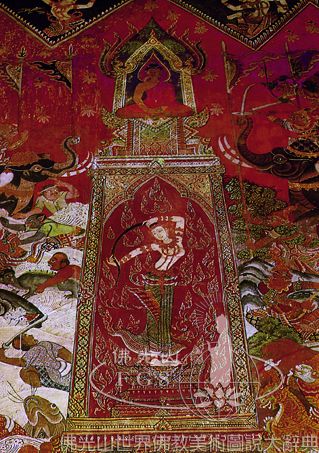
When the Buddha was on the verge of attaining enlightenment, Mara sent an army of demons to distract him. However, the Buddha remained unshaken, subdued the demons, and called forth Prthivi, the Earth Goddess, to witness his accomplishment. She sprang from the earth, wrung water out of her long hair, and released a flood, washing away the army.
Murals depicting this story are usually painted on lintels above doorways in Thai temples to remind departing devotees of the accomplishment of the Buddha. The mural is found in the upper register of the east wall of the ordination hall. At the top of the mural, Sakyamuni Buddha sits on a diamond throne and forms the dhyana (meditation) mudra. He has a petal-shaped nimbus and is surrounded by an elegantly decorated arch. Below the Buddha, the large figure of the Earth Goddess stands on an ornate pedestal within a square frame covered with patterns. Adorned with ornaments, she bends her body and wrings water out of her black hair. Her lower body is covered by an elegant dhoti with pointed hems that resemble fish tails.
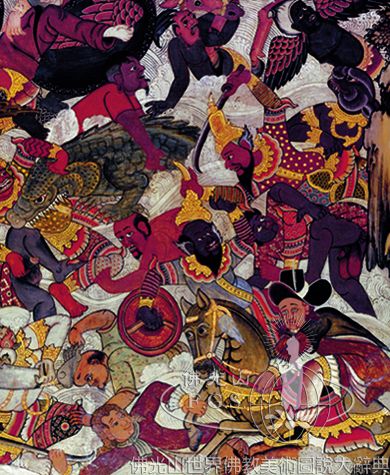
The demon army is depicted to either side of the two central images. On the upper right, Mara is shown riding on the back of a black elephant, leading the attack. On the left, demons are swept away in the flood or are attacked by crocodiles. Mara is depicted again on the upper right, joining palms and paying homage to the Buddha in defeat. The demon army includes long-haired, gentlemanly westerners, hinting at the historical complexities of the era. The figures and animals are detailed and vividly colored. A powerful contrast is created between the intricately patterned, orderly central image and the chaos on either side, emphasizing the Buddha's triumph over suffering and delusion. |