|
Xinghua Temple Murals
|
| |
 |
Xinghua Temple Murals
|
| |
 |
Xinghua Temple Murals
|
| |
 |
Xinghua Temple Murals
|
| |
 |
Xinghua Temple Murals
|
| |
 |
Xinghua Temple Murals
|
| |
|
Xinghua Temple Murals
CHINA, Shanxi, Yuncheng; Yuan dynasty (1271–1368); Jishan County Museum, Shanxi, China
These murals were originally located in Xinghua Temple. According to the Jishan County Gazetter, the temple was built in 592 and was reconstructed during the Yuan dynasty (1271-1368). The middle and rear halls were covered with murals which, according to inscriptions, were painted by the famous Yuan dynasty artists Zhu Haogu and Zhang Boyuan in 1298. In 1303, when Pingyang (present day Linfen, Shanxi) was hit by a strong earthquake, the temple and the murals were damaged. However, they were restored during the late Yuan and Ming (1368-1644) dynasties.
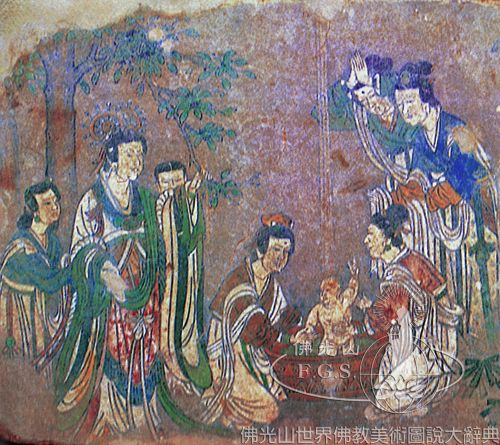
In the 1920s, large sections of the murals were stripped off and taken away. An illustration of the Sutra on the Descent of Maitreya is currently collected in the Royal Ontario Museum in Toronto, Canada, and a depiction of the Seven Buddhas is in the Palace Museum in Beijing, China. A small section of the murals illustrating the Birth of Prince Siddhartha is now kept in Jishan County Museum. The temple has been destroyed; there is now farmland where it once stood.
In the mural depicting the Birth of Prince Siddhartha, Queen Maya is on the left, grasping a branch of the asoka tree with her left hand. On the right, the newborn prince stands in a basin and is washed by a stream of water that pours from the heavens. The prince points up at the sky with his left hand and down at the ground with his right, proclaiming I vow to liberate all who suffer in the heavens above and earth below." Two palace maids kneel beside the basin |