 |
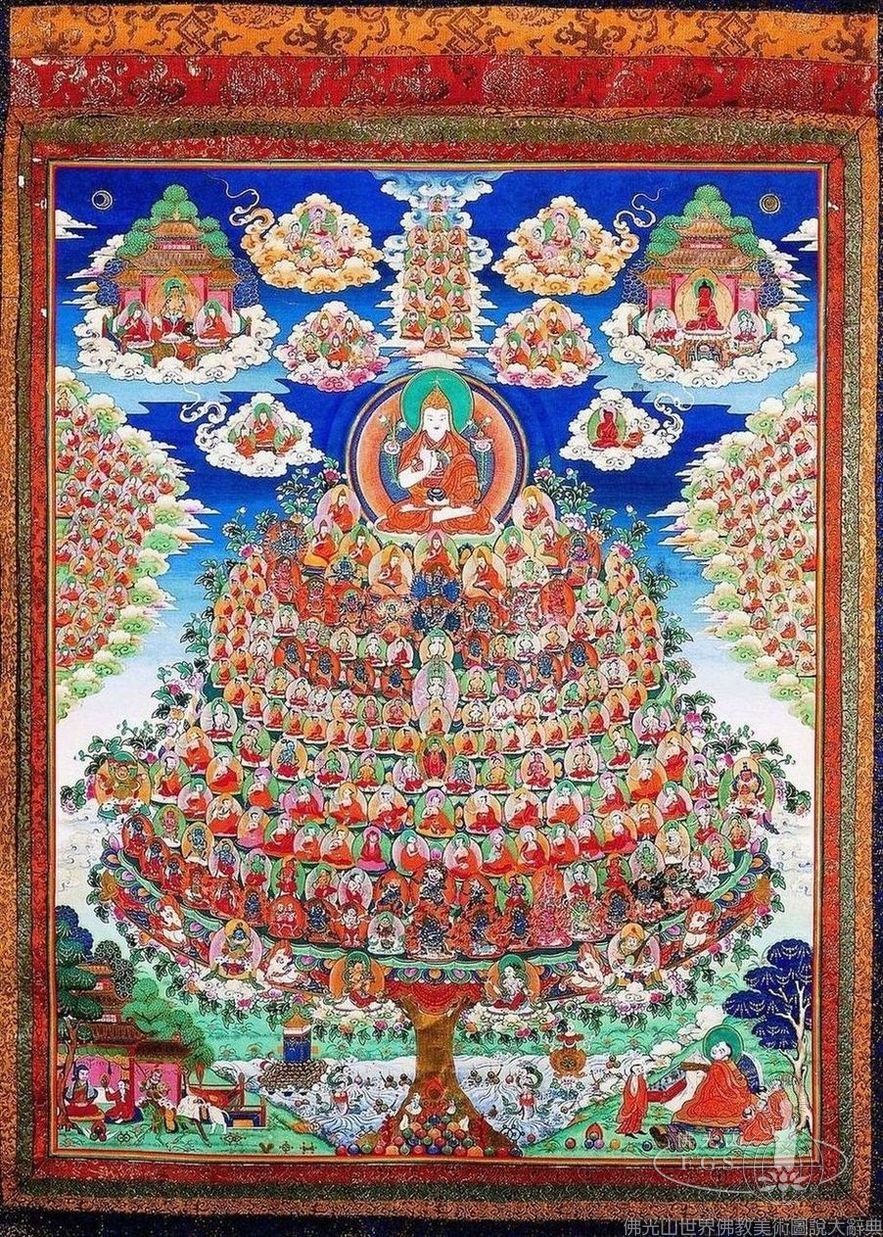
Yonghe Temple: Gelug Lineage Tree
|
| |
|
Yonghe Temple: Gelug Lineage Tree
CHINA, Beijing; Qing dynasty (1644–1911); Color on cloth; 63.5 x 50 cm
In this intricate thangka, the lineage holders of the Gelug school are arranged within the leaves of a large tree or float on clouds around a central image of Tsongkhapa, who founded the school in the 15th century. The Buddhas, Bodhisattvas, and Dharma protectors venerated by the school are also portrayed. Thangkas like this usually come in pairs, and are used by the monastics of the Gelug school to visualize and take refuge in spiritual ancestors.
Tsongkhapa sits in full lotus position at the top of the lineage tree, wearing a pointed hat and an orange monastic robe. The left hand cradles an alms bowl and the right hand is raised in the vitarka (teaching) mudra. Lotus flowers rise beside his shoulders; one is topped with a sutra and the other supports a sword. These two objects are associated with Manjusri Bodhisattva, and thus indicate that Tsongkhapa is a manifestation of Manjusri.
Lineage holders, Dharma protectors, Bodhisattvas, Arhats, Pratyekabuddhas, dakinis, and the Four Heavenly Kings cover the tree below Tsongkhapa. Each figure is surrounded by a colorful mandorla. More lineage holders float on clouds in the upper register. The heavenly palace in the upper left corner represents Avalokitesvara's Pure Land. The Western Pure Land of Amitabha Buddha is painted in the upper right corner. At the foot of the tree, naga kings rise from the water and offer jewels. Eminent monks chant in the lower corners.
The thangka represents an interesting blend of Chinese landscape painting techniques and traditional Tibetan art. The colorful clouds in the upper register are a common feature of this Sino-Tibetan painting style. |