|
Lotus Sutra
|
| |
 |
Lotus Sutra
|
| |
 |
Lotus Sutra
|
| |
 |
Lotus Sutra
|
| |
 |
Lotus Sutra
|
| |
|
Lotus Sutra
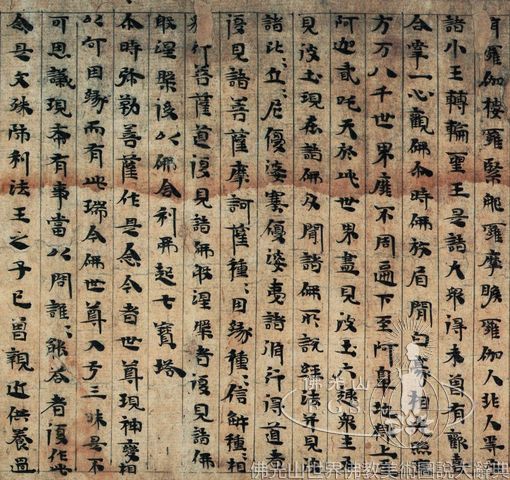
CHINA; Eastern Jin dynasty (317–420); Regular script; Ink on paper; 23.5 x 41.3 cm; National Museum of China, Beijing
The Lotus Sutra proposes that the practices of the Sravakas, the Pratyekabuddhas, and the Bodhisattvas belong to the same Buddha path, and advocates that every sentient being holds the potential to become a Buddha. This Lotus Sutra manuscript was created by mounting 14 partially damaged sections together, with black ink column guidelines lining the text. Sections 9, 11, and 14 were written on yellow paper, and they date from the early Tang dynasty (618-907). The remaining parts were written on white paper during the Six Dynasties (220-589). The number of lines and characters within each section differs.
During the Six Dynasties, there was rapid development in Buddhism. Transcribing sutra manuscripts is regarded as an act of immense merit and became a prevalent feature of Buddhist culture. Chinese calligraphy went through a turning point during the transition from clerical to regular script in the time of the Three Kingdoms (220-280) and the Western and Eastern Jin (265-420) dynasties.
This example is a Jin dynasty manuscript, which comprises the second part of the Introductory Chapter" of the Lotus Sutra. It is sparsely composed with compact characters |