|
Skull Bowl
|
| |
 |
Skull Bowl
|
| |
 |
Skull Bowl
|
| |
 |
Skull Bowl
|
| |
 |
Skull Bowl
|
| |
 |
Skull Bowl
|
| |
|
Skull Bowl
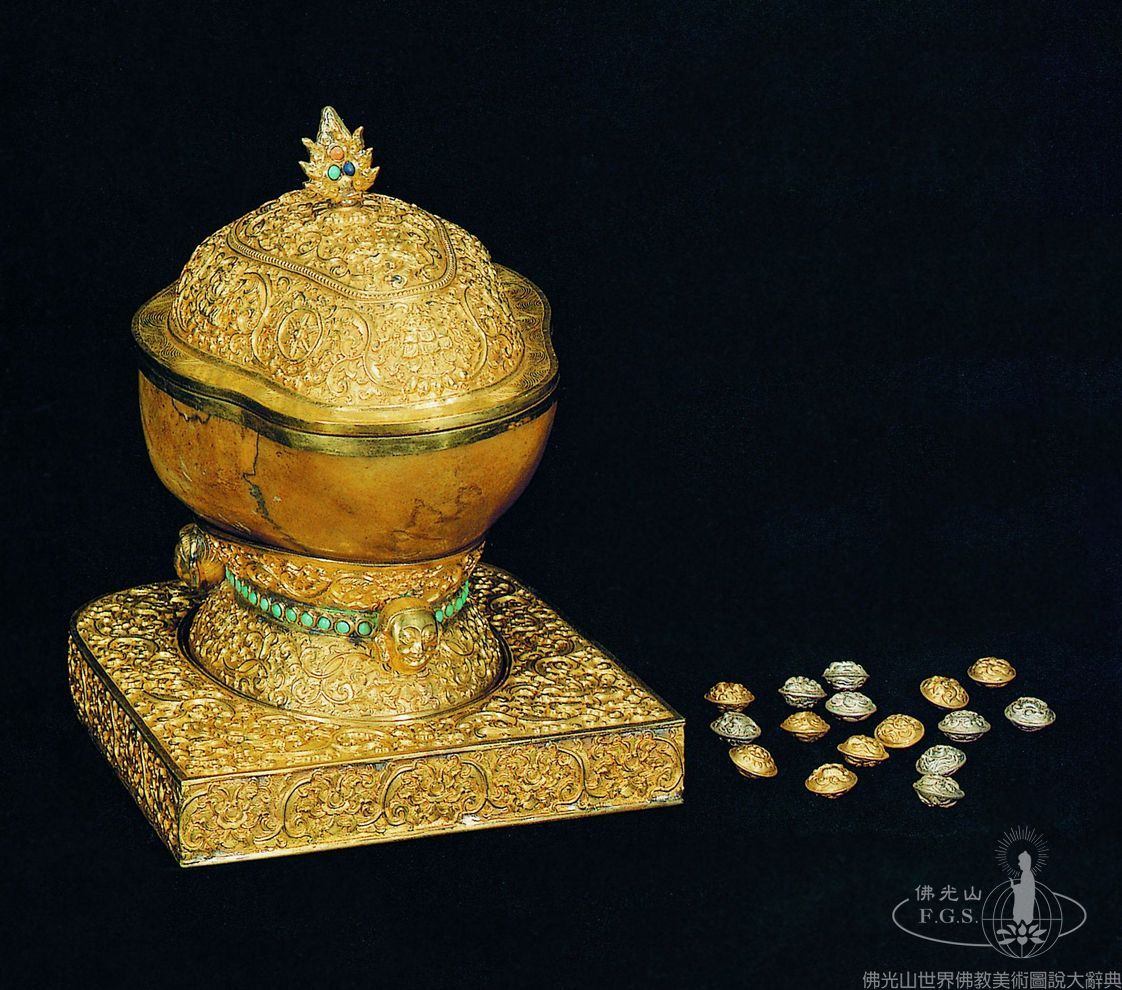
CHINA; Qing dynasty (1644–1911), dated 1793; Bone and gilt copper alloy; H: 22.2 cm; National Palace Museum, Taipei, Taiwan
This human skull bowl was a gift to Emperor Qianlong (reigned 1736-1795) of the Qing dynasty from Yeshe Lobzang Tenpai Gonpo in 1793. It is a ritual vessel used in Tibetan Vajrayana practice.
The bowl rests upon a Sumeru base, which itself stands on a square base. The two sections of the base have lotus patterns in repousse. The concave part of the Sumeru base is decorated with a ring of turquoise beads, with a head of the Buddha attached in three places. The whole unit is 22.2 cm high, while the bowl itself is 8.2 cm high. In the center of the lid, there is a flame-shaped knob inlaid with three jewels. The lid is decorated with lotuses and the eight auspicious symbols in repousse, and the mouth of the bowl and the interior are gilded.
On the back of the skull, there are two deep brown marks that look like the Sanskrit seed syllables om" and "hum." According to the Vajrayana tradition |