 |
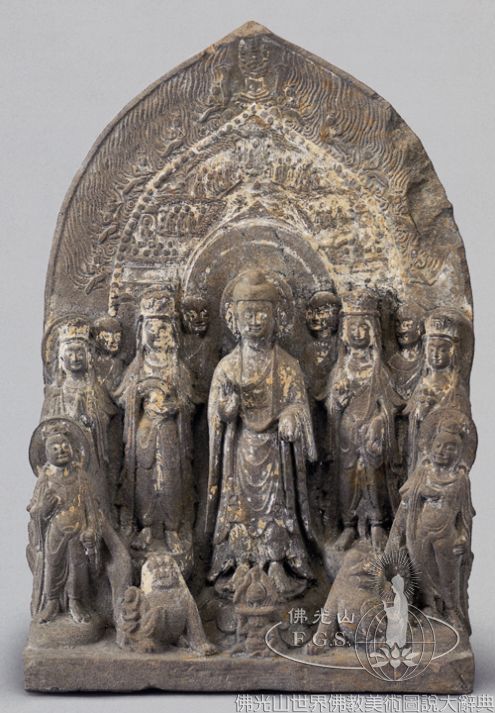
Chengdu: Sakyamuni Buddha and Attendants
|
| |
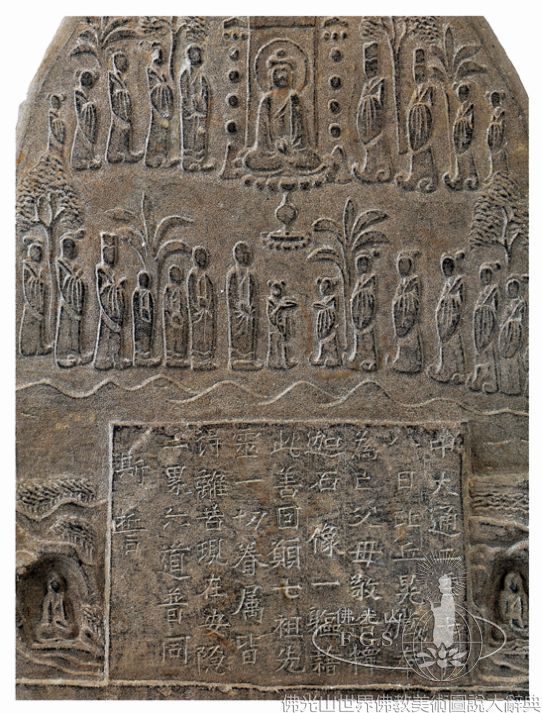 |
Chengdu: Sakyamuni Buddha and Attendants
|
| |
|
Chengdu: Sakyamuni Buddha and Attendants
CHINA, Sichuan, Chengdu; Southern Liang dynasty (502–557), dated 530; Commissioned by Huangzang; Sandstone; H: 38.5 cm; Chengdu Museum, Sichuan, China
This sculpture was excavated in 1995 and depicts a large group of figures consisting of Sakyamuni Buddha, four Bodhisattvas, four disciples, two Heavenly Kings, and two lions. Sakyamuni Buddha stands on a lotus pedestal and wears a monastic robe that leaves the right shoulder bare. The Buddha most likely forms the abhaya (fearlessness) and varada (wish-granting) mudras. The four Bodhisattvas, two on either side of the Buddha, wear tall headdresses with ribbons hanging from them and stoles that cross in front of the abdomen. The four disciples at the back are depicted in low relief. The two remaining figures are the Heavenly Kings who carry Dharma instruments. At the foot of the Buddha, a warrior supporting a mountain censer on his head is flanked by two Dharma-protecting lions.
The mandorla has a pointed arch and is filled with images, mainly of the assembly at Vulture Peak who converged to listen to the Buddha's teachings. Apsaras with their stoles styled into flames line the sides of the mandorla.
Low reliefs showing the Buddha teaching the Dharma are on the back of the mandorla. A mountain censer is placed before the Buddha. The inscription in the lower register states that the sculpture was dedicated by the monk Huangzang in 530 for the benefit of many. There are niches on either side of the inscription. |