 |
Zishou Temple Murals
|
| |
 |
Zishou Temple Murals
|
| |
 |
Zishou Temple Murals
|
| |
 |
Zishou Temple Murals
|
| |
 |
Zishou Temple Murals
|
| |
 |
Zishou Temple Murals
|
| |
|
Zishou Temple Murals
CHINA, Shanxi, Jinzhong; Ming dynasty (1368–1644)
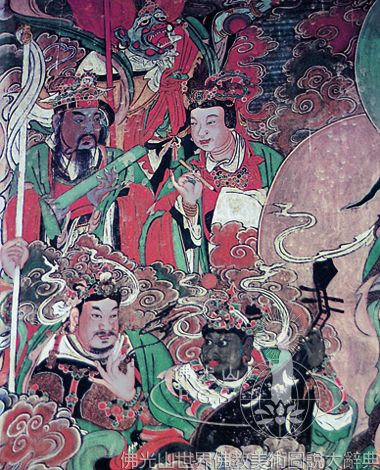
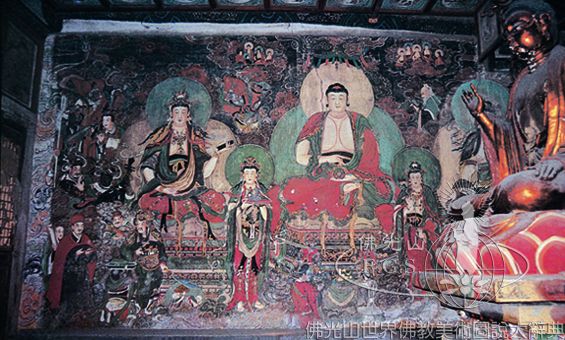
These murals are located in the Great Hero Hall, the Medicine Buddha Hall, and the Amitabha Hall of Zishou Temple, covering 161.32 sq m in total. They were all painted soon after each hall was constructed during the Ming dynasty.
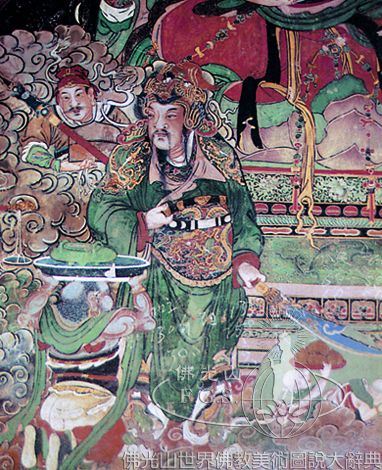
The east and west walls of the Great Hero Hall are decorated with large scenes of assembled beings listening to the Medicine Buddha and Sakyamuni Buddha teach the Dharma. Suryaprabha and Candraprabha Bodhisattvas sit beside the Medicine Buddha on the east wall, while Sakyamuni is flanked by Manjusri and Samantabhadra Bodhisattvas on the west wall. The legendary hero Guan Yu, rarely seen in Ming dynasty temple murals, is depicted in the lower left corner on the west wall. He holds a bladed staff and wears a general's headdress, a war-gown, and a large belt decorated with an image of a dragon.
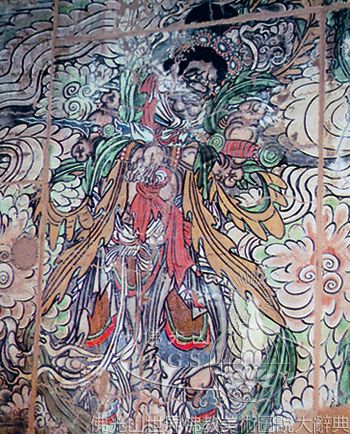
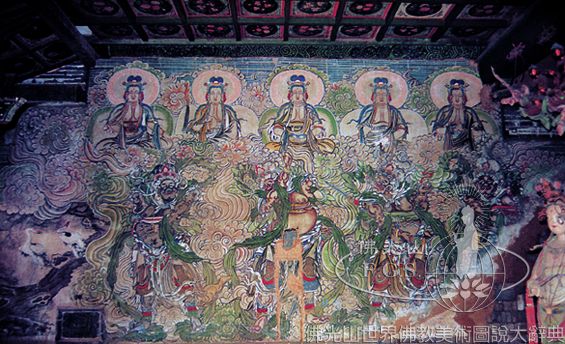
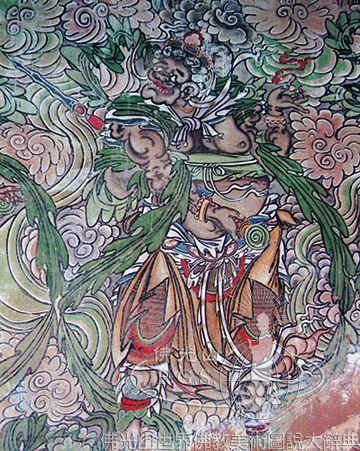
According to inscriptions written on the beams and eaves, the Medicine Buddha Hall, also known as the Hall of Seven Buddhas, was built in 1499. Murals were painted shortly after. On each wall, five Bodhisattvas sit in the clouds in the upper register and four of the Eight Classes of Dharma Protectors are shown below. The Eight Classes of Dharma Protectors have muscular arms and exaggerated features. They wear armor and stand in striking poses, surrounded by clouds. Stoles with ruffled edges billow around their arms. These murals are painted in a vivid, unrestrained style; the clouds in the background are particularly striking.
In the Amitabha Hall, also known as the Water and Land Hall, a seated Buddha and the Eight Wisdom Kings are depicted on the two side bays of the back wall. The upper registers of each of the side walls once featured ten seated Buddhas; only five still remain on the west wall. In the middle and lower registers of the west wall, there are images of heavenly beings and the Eight Classes of Dharma Protectors. The mural on the east wall has been destroyed. According to the Stele of the Construction of the Water and Land Hall dated to 1516, the murals were painted in 1482. Traces of repainting have been discovered, likely done during the Qing dynasty (1644-1911). |