 |
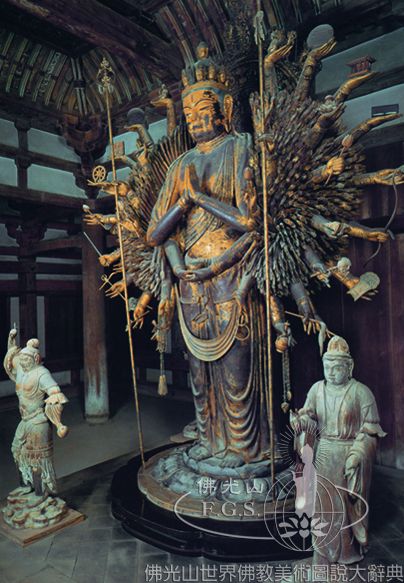
Toshodaiji Temple Golden Hall: Thousand-Armed Avalokitesvara
|
| |
|
Toshodaiji Temple Golden Hall: Thousand-Armed Avalokitesvara
JAPAN, Nara; Nara period (710–794); Wood; H: 535.7 cm
This statue was possibly sculpted by Chinese monk Rubao, a disciple of Master Jianzhen. It is known to be the largest and earliest sculpture of the Eleven-Headed Avalokitesvara, and the design is based on the descriptions from the Sutra on the Vajrayana Teachings of Avalokitesvara Bodhisattva. The statue dates from the end of the 8th century. It is assembled from several wood blocks and subsequently lacquered and painted. The statue was listed as a National Treasure in 1952.
Ten faces surround the crown, which is fronted with a standing Buddha and surmounted by a Buddha head. Examples such as this figure with all thousand arms are rare. Nine hundred and eleven miniature arms with their raised palms arrayed about the body remain on this statue. The miniature arms are interspersed with 42 main arms, most of which hold Dharma implements, symbols, or attributes. The upper pair of the hands joined before the body is in anjali (reverence) mudra and the lower pair hold a bowl. The Bodhisattva stands barefoot on a 53 cm high lotus pedestal. The impressive original design has been maintained despite several renovations over the years. |