 |
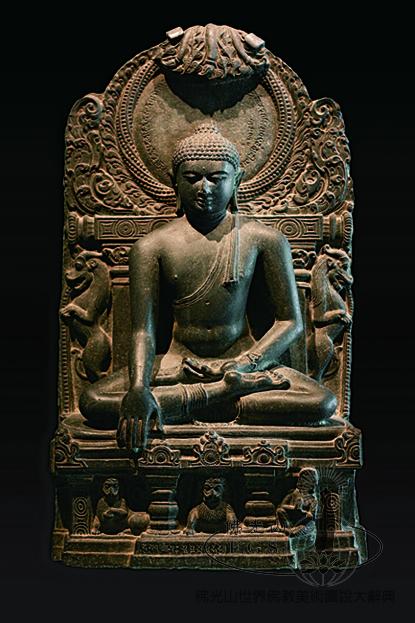
Bihar: Seated Buddha
|
| |
|
Bihar: Seated Buddha
INDIA, Bihar; circa 9th century; Commissioned by Prajnaprabha; Stone; H: 82.5 cm; Asian Art Museum of San Francisco, USA
This sculpture was excavated in Bihar and is a fine example of Pala (circa 8th-12th century) artwork, with the main statue carved in high relief and the background in low relief. The Buddha has fine curly hair, a round face, and a small urna between the eyebrows. The monastic robe just covers the left shoulder and the hem of the garment can be seen fanned out on to the throne. Seated in full lotus position, the figure makes the bhumisparsa (earth-touching) mudra with the right hand, while the left hand rests in the lap. A Dharma wheel is visible on the palm and sole of the foot.
The nimbus consists of three concentric circles: the outer circle is made of flames, the middle circle is a twisted bead pattern, while the inner circle is plain except for a ring of inscriptions. A canopy of Bodhi leaves and branches is located at the top of the nimbus. Mythical creatures standing on their hind legs are on either side of the Buddha's throne. The area beneath the throne is divided into three niches: the middle and left niche contain a crouching lion, while the right niche has a seated devotee with his palms joined. The figure is probably also the donor. An inscription carved in the center of the bottom edge of the base identifies the donor as an elder called Prajnaprabha. |