 |
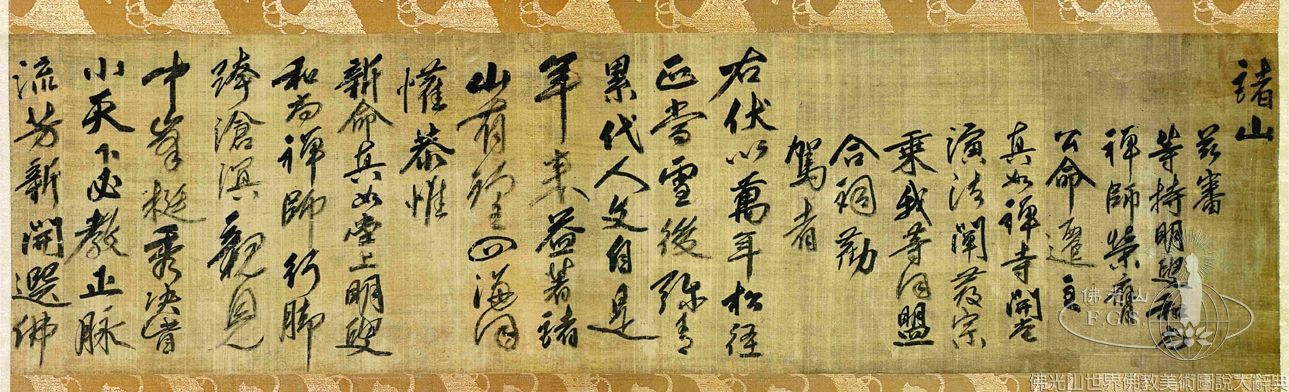
Ryokoin Temple: Congratulatory Note to Master Myoso Saitetsu
|
| |
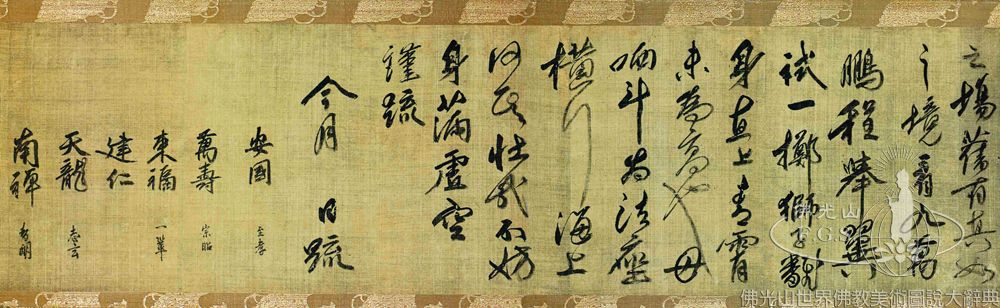 |
Ryokoin Temple: Congratulatory Note to Master Myoso Saitetsu
|
| |
|
Ryokoin Temple: Congratulatory Note to Master Myoso Saitetsu
JAPAN, Kyoto; Nanbokucho period (1336–1392), dated 1346; By Zhuxian Fanxian; Running-cursive script; Handscroll; Ink on silk; 39 x 146 cm
This work was written by Zhuxian Fanxian, a Chinese Chan monk who went to Japan to propagate the Dharma. There, he was better known as Jikusen Bonsen. Zhuxian wrote this calligraphy when Zen Master Myoso Saitetsu became the abbot of Shinnyoji Temple in Kyoto. The piece records the opening of a lecture hall in the temple, but the text also contains congratulatory notations and praise for Myoso. Hopes and well-wishes for Master Myoso's impending abbotship are offered, filling the essay with joy and expectations of a bright future. Written in 1346 of the Nanbokucho period (1336-1392), the scroll was listed as a National Treasure of Japan in 1952.
This calligraphic work exhibits the influence of several renowned calligraphers of the Song dynasty (960-1279). Two such influences are Huang Tingjian and Fan Chengda. Brushstrokes are especially pronounced, conveying a distinct character composition. The spacious layout sets a natural mood to the piece. Swift cursive script brushwork yields an ethereal style, adding dynamism and intensity. Changes in writing pace, in combination with variation in the weight of each stroke, impart an overall sprightly and smooth rhythm. |