 |
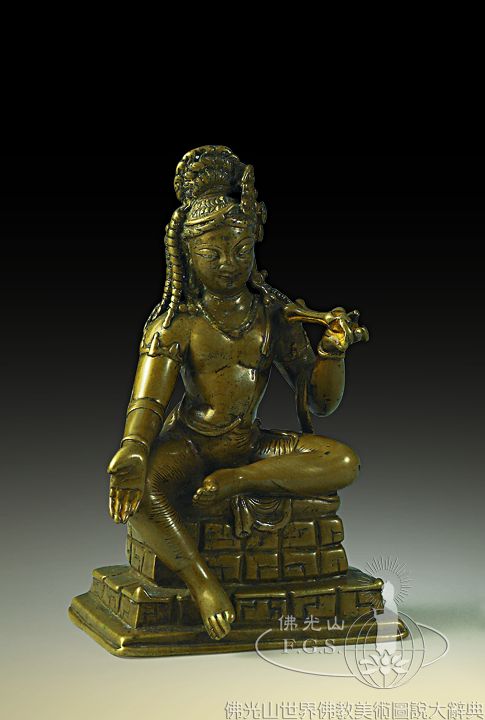
Vajrapani Bodhisattva
|
| |
|
Vajrapani Bodhisattva
INDIA / PAKISTAN; circa 8th–9th century; Bronze; H: 15.4 cm; National Palace Museum, Taipei, Taiwan
Vajrapani is seated in the relaxation posture on a stepped throne, a position that inclines the body and head to one side. The style of the throne is predominantly seen in statues from the Swat region of Pakistan and in Kashmir. The left hand holds a short vajra toward the shoulder, while the right hand is extended downward in varada (wish-granting) mudra.
The Bodhisattva 's elaborate topknot is confined behind a simple crown, over which long curls tumble to the shoulders. A stole winds over one arm, while a tight skirt rides up one leg and overhangs the top of the throne. The eyes are inlaid with silver and the mouth with copper. The statue and throne were cast as a single piece, but the fan-shaped hair-support and vajra were cast separately and added later, which accounts for the awkward way in which the latter is held. A circular mortise behind the head and a tenon on the back are thought to have originally secured a nimbus. |