 |
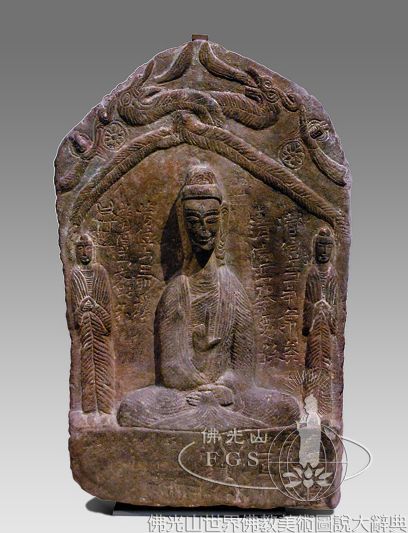
Buddha and Attendants
|
| |
|
Buddha and Attendants
CHINA; Northern Wei dynasty (386–534), dated 528; Sandstone; Guimet Museum of Asian Art, Paris, France
The sculpture is believed to have originated from the Weihe Plain in Shaanxi, since it shows stylistic characteristics of that area. The Buddha has a long narrow face with prominent features and a slim body. He has a high usnisa and elongated earlobes. The monastic robe covers both shoulders, while the hem hangs down to the abdomen. The figure is seated in full lotus position and forms non-standard mudras. The attendant Bodhisattvas also form unusual mudras. The back screen includes two intertwined dragons, two apsaras, and two Dharma wheels. There are inscriptions on either side of the Buddha and on the base. |