 |
White Lotus Society
|
| |
 |
White Lotus Society
|
| |
|
White Lotus Society
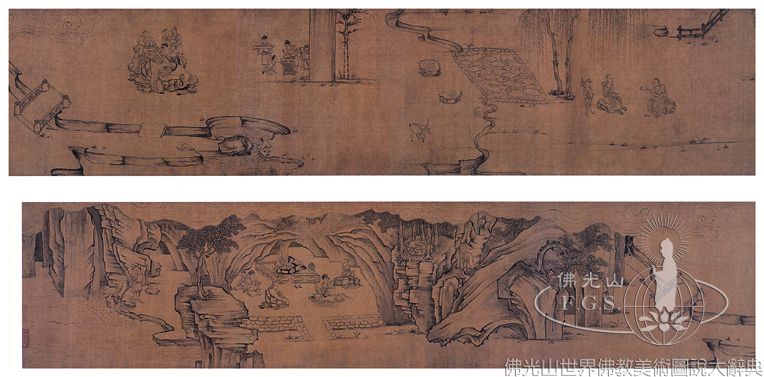
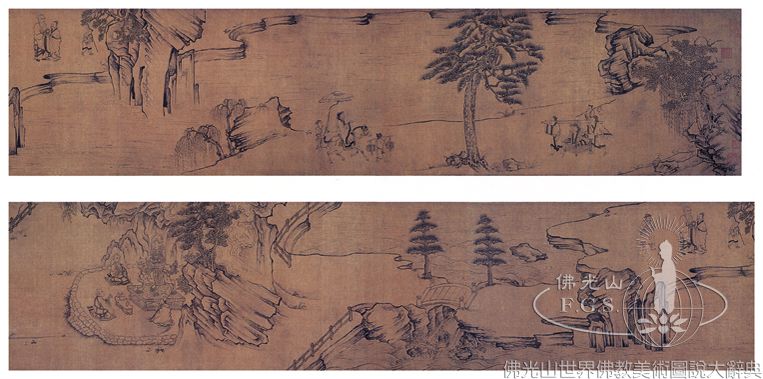
CHINA; Southern Song dynasty (1127–1279); Ink on silk; 60.1 x 459.8 cm; Shanghai Museum, China
In 381 of the Eastern Jin dynasty, Master Huiyuan went to stay at Donglin Temple, which is located on Lushan (Cottage Mountain) in Jiangxi. Many sought the Dharma from him. In 402, Huiyuan and more than a hundred others made a vow before an image of Amitabha Buddha, uniting under a shared resolution to practice the samadhi of being mindful of the Buddha, and to attain rebirth in the Western Pure Land. Named after the white lotuses in the pond at Donglin Temple, the society gradually grew in number, eventually developing into the Pure Land school in the Late Tang period (846-907) and early Song dynasty (960-1279). This picture depicts the story of the society's formation and their practice.
There is no signature on this painting, though there are seal imprints from the Ming dynasty (1368-1644) and an inscription from the Qing dynasty (1644-1911). The scenes are very similar to those in another picture of the founding of the society kept in the Nanjing Museum, except for the horizontal rather than vertical orientation. Both artworks may be copies of the painting White Lotus Society done by Li Gonglin during the Northern Song dynasty (960-1127).
The scenes in the painting include depictions of Huiyuan and Lu Xiujing meeting each other and engaging in cheerful banter, Tanchang, Daobing, and Zhouxu paying respect to a statue of a Bodhisattva on a golden lion, Tanshun and Zongbing returning from the mountains, Daosheng sitting on a platform and teaching Tanshen, Daojing, and Lei Cizong, and Zhang Laimin washing his feet and observing a waterfall. Neat, simple strokes give the scenes an ethereal feel. |