 |
Seula Monastery: Four-Armed Avalokitesvara
|
| |
|
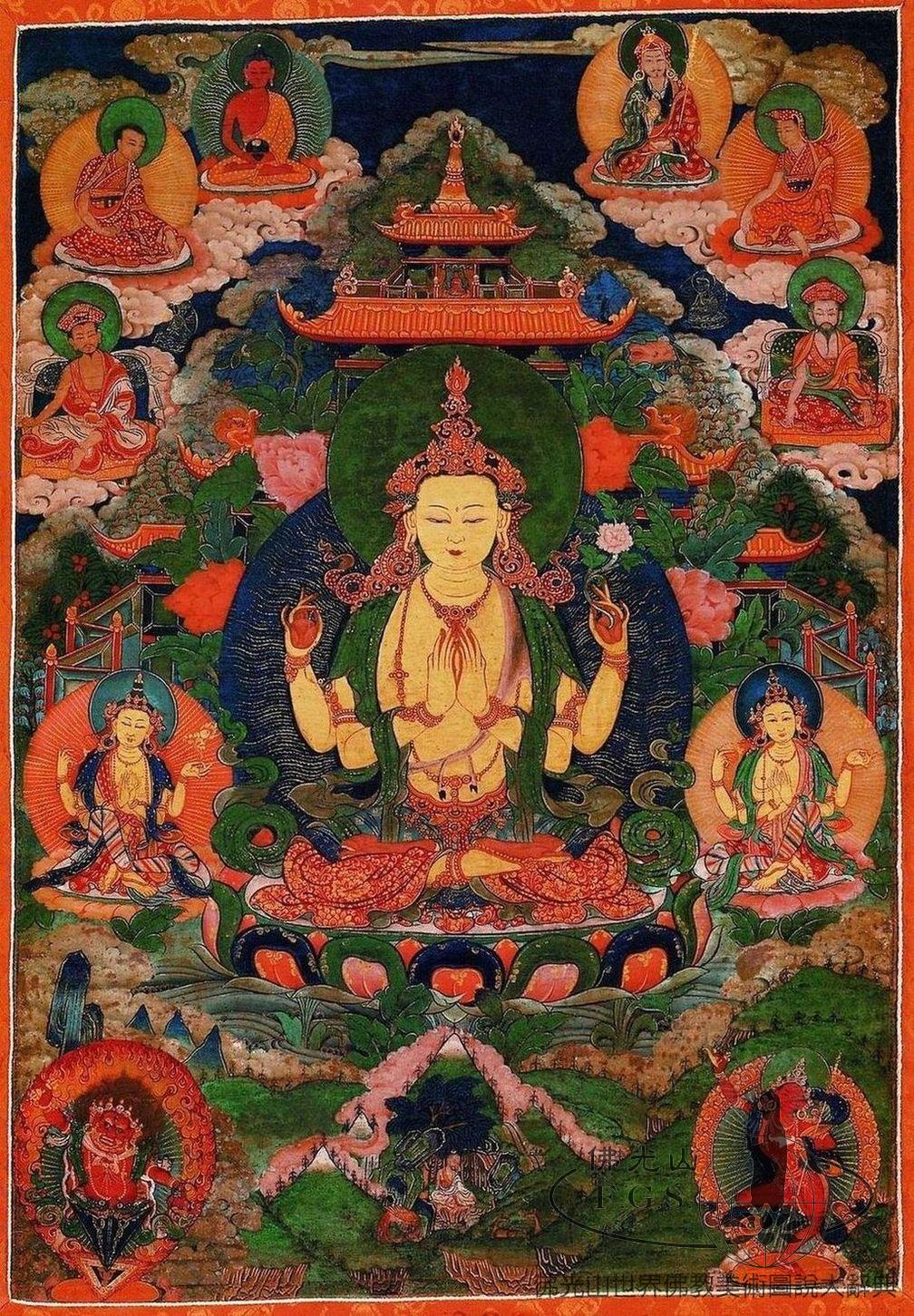
Seula Monastery: Four-Armed Avalokitesvara
BHUTAN, Punakha; Late 17th century–early 18th century; Ink and color on cotton; 135.9 x 92.5 cm
In this thangka, Four-Armed Avalokitesvara Bodhisattva sits on a lotus throne in the center of the painting, wearing an ornate headdress topped with a flaming jewel. Narrowed eyes and closed lips give the Bodhisattva a serene appearance. Earrings and ornaments decorate the golden body and a stole encircles the arms. An antelope skin is draped over the left shoulder. The patterned dhoti is folded delicately around the legs. Two hands with red palms are joined in front of the chest, appearing to hold a wish-fulfilling jewel. The other right hand holds a string of prayer beads, and the corresponding left hand holds a lotus. An image of Amitabha Buddha sits in the palace above the Bodhisattva. Two smaller images of the Avalokitesvara flank the central figure.
Buddhas, Dharma protectors, and eminent monks are painted in the upper corners. On the left beside the spire of the palace is the red Amitabha Buddha; Padmasambhava is on the right, holding a vajra and a skull cup. The figures below Amitabha are Kunkhyen Pema Karpo, the great 16th century Kagyu school master, and Yab Mipham Tenpei Nyima. Khedrup Lhawang Lhodro and Shabdrung Ngawang Namgyal (reigned 1616-1651) are painted below Padmasambhava on the right.
A small figure is shown meditating in a cave in the mountains in the center of the lower register. In the lower left corner, the wrathful red Dragmar impales a small human body with a triangle. In the opposite corner, the red Vajrayogini stands in a dynamic pose on a sun disc, appearing to dance. |