 |
Chu Suiliang (596-658)
|
| |
|
Chu Suiliang (596-658)
CHINA, Zhejiang, Hangzhou; Tang dynasty (618–907)
Chu Suiliang, also known as Dengshan, was a calligrapher and government official during the rule of Emperor Taizong (reigned 626-649) of the Tang dynasty. He was later appointed the Duke of Henan and was known for his resolute and upright character. Chu's works were mostly related to Buddhism, and alongside Ouyang Xun, Yu Shinan, and Xue Ji, he is regarded as one of the Four Great Calligraphers of the Early Tang period (618-712).
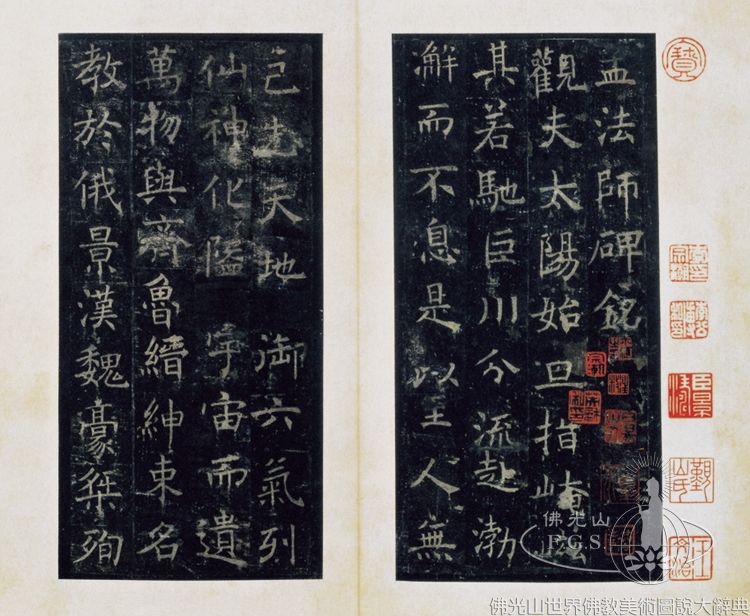
Proficient in regular script calligraphy, Chu structured his writings in the styles of other eminent calligraphers. He incorporated the sparse and thin lines of Shi Ling's calligraphy, the rigorous approach of Ouyang Xun, the gracefulness of Yu Shinan, and the ornate touches of Wang Xizhi and Wang Xianzhi. With all these characteristics in one script, Chu created a new calligraphic style that was very much his own. His characters are short with long, downward brushstrokes and irregularly spaced dots and line strokes.
Calligraphic works by Chu include the Yique Buddha Niche Inscription at the Longmen Grottoes in Luoyang, Henan; a rubbing of the inscription is now kept at the Palace Museum in Beijing. He also wrote the Stele of Monk Meng, the rubbing of which is at the Mitsui Memorial Museum in Tokyo, and Preface to Sagely Teachings at Dayan Pagoda, the original stone of which is still located in Daci'en Temple in Xi'an, Shaanxi, and the rubbing is kept at the National Library of China in Beijing. |