 |
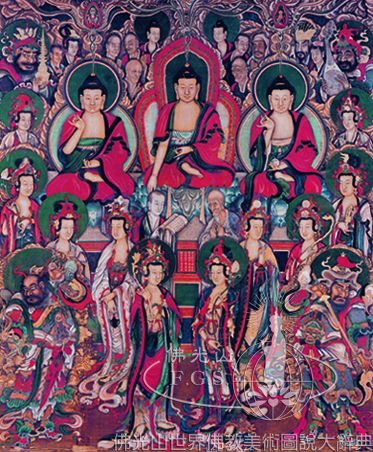
Yongjusa Temple Great Hero Hall: Assembly of Three Buddhas
|
| |
|
Yongjusa Temple Great Hero Hall: Assembly of Three Buddhas
SOUTH KOREA, Gyeonggi, Hwaseong; Joseon dynasty (1392–1910), dated 1790; Ink and color on silk; 440 x 350 cm
This altar painting is kept in the Great Hero Hall of Youngjusa Temple. Thought to have been made by the renowned Korean artist Kim Hong-do when the temple was rebuilt in the late 18th century, it is listed as Tangible Cultural Property No. 16 of Gyeonggi.
The red-robed Sakyamuni Buddha sits on a white lotus throne in the center of the painting, flanked by the slightly smaller Amitabha Buddha on the left and Medicine Buddha on the right. Intertwining lines rise from the jewels atop the usnisas of each Buddha. The heads of two Buddhas are visible on either side of Sakyamuni's petal-shaped nimbus. Above the circular nimbuses of Medicine Buddha and Amitabha, there are small Buddha images with bright mandorlas. Mahakasyapa and Ananda stand below Sakyamuni Buddha's lotus throne. Avalokitesvara and Mahasthamaprapta Bodhisattvas are depicted below Amitabha. Below the Medicine Buddha are Suryaprabha and Candraprabha Bodhisattvas. Manjusri and Samantabhadra Bodhisattvas are shown holding lotuses in the center of the lower register. Two of the Four Heavenly Kings stand in the lower corners, dressed in beautifully detailed suits of armor. Two Bodhisattvas and the other two Heavenly Kings are depicted along the sides of the picture. Heavenly beings and disciples are partially visible within tangled knots of cloud in the remaining spaces. In the cartouche on the base of Sakyamuni's throne, there is an inscription of prayers for the long life of the king and royal family. The dark tone of the painting differs from most other Korean Buddhist artworks from the same period. The delicate washes of color that give the figures a striking three-dimensional appearance are also unique. |