 |
White Lotus Society
|
| |
 |
White Lotus Society
|
| |
 |
White Lotus Society
|
| |
|
White Lotus Society
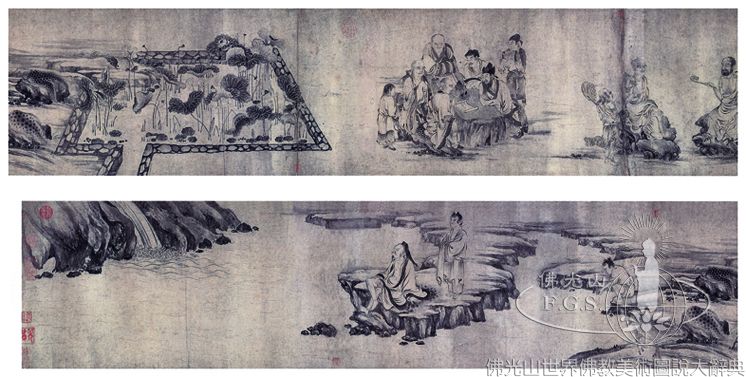
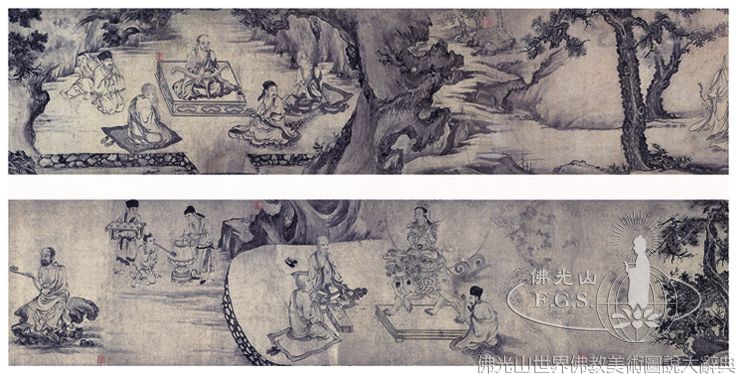
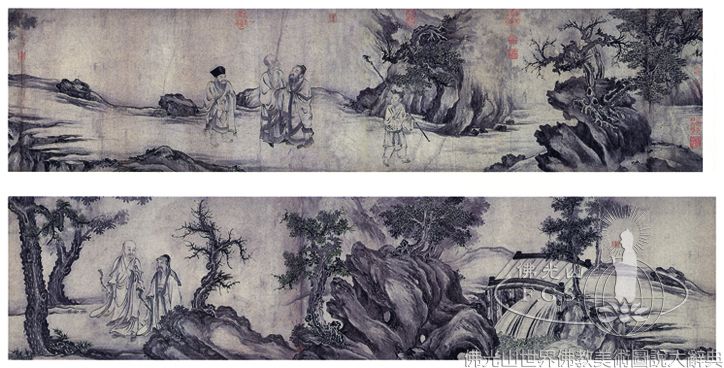
CHINA; Northern Song dynasty (960–1127); By Zhang Ji; Handscroll; Ink on paper; 35 x 849 cm; Liaoning Provincial Museum, Shenyang, China
This scroll illustrates the story of the founding of the White Lotus Society by Master Huiyuan and his companions at Donglin Temple on Lushan (Cottage Mountain) in Jiangxi during the Eastern Jin dynasty (317-420). It was kept in the Imperial Palace during the Qing dynasty (1644-1911), and now resides in the Liaoning Provincial Museum. Although records attribute the artwork to Li Gonglin, there is no signature on the scroll. However, in an inscription, Li's nephew Zhang Ji claims to have been the artist. Thus, this is possibly Zhang's imitation of Li's original artwork White Lotus Society.
Seven distinct scenes are separated by trees and mountains. First, Master Huiyuan is shown chatting cheerfully with Lu Xiujing while two attendants look on. Next, Tanshun and Zongbing are depicted returning from their exploration of the mountains. In the third scene, Daosheng sits on a platform, giving a teaching to Tanshen and Daojing while Lei Cizong looks on, holding a white feather.
The fourth scene shows Tanchang, Daobing, and Zhouxu paying respect to a statue of a Bodhisattva riding a golden lion, and in the fifth, Buddhayasa and Buddhabhadra sit facing each other on rocks and conversing. Next, Huiyong, Huichi, Huirui, Liu Yimin, and Zhang Quan are portrayed sitting around a stone table reading sutras, and in the final scene, Zhang Laimin washes his feet and observes a waterfall.
There are inscriptions on the back of the scroll by notable Song dynasty (960-1279) figures including Li Desu, Zhang Ji, Zhan Lingshi, Fan Tun, Jing Tang and Zhao Bumian. Li Desu's inscription identifies the figures in the illustration. The figures are drawn with smooth strokes, while lines of varying thickness add texture to the landscapes, resulting in a rich, diverse image. The lotus flowers that rise from the pond beside the figures seated around the table are illustrated in an elegant, simplistic manner rarely seen in Song style art. |