 |
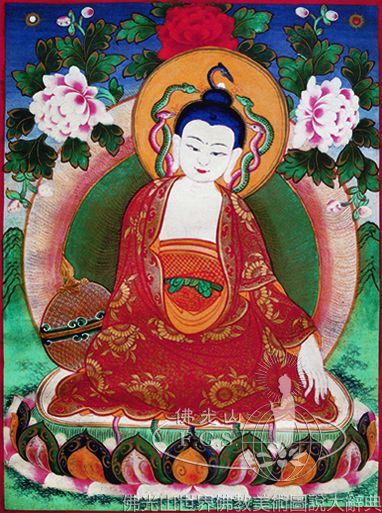
Yonghe Temple: Nagarjuna Bodhisattva
|
| |
|
Yonghe Temple: Nagarjuna Bodhisattva
CHINA, Beijing; Qing dynasty (1644–1911); Color on cloth; 30 x 21 cm
Nagarjuna was a renowned Buddhist philosopher who lived during the 2nd or 3rd century. Born into a brahmin family in southern India, he encountered Theravada Buddhism at an early age, then traveled to the Himalayas and studied Mahayana scriptures. He combined the teachings of the two traditions, wrote many treasured texts explaining complicated points of Buddhist thought, and founded the Madhyamaka school.
In the painting, Nagarjuna is portrayed as a serene Bodhisattva sitting on a lotus throne. Dressed in an ornate patterned robe, he tilts his head to one side and extends his left hand downwards. A yellow nimbus surrounds his head. Five snakes rise up from behind his shoulders, a symbolic reference to a legendary story that tells of Nagarjuna traveling to the palace of the naga kings to acquire Mahayana scriptures. A spherical vessel for purification, an item used daily by Indian religious practitioners, is placed on the side of Nagarjuna.
Fine details and rich coloring indicate that the thangka was painted by an artist of the New Menri school. Founded by Menla Dondrup, the school had a great influence on Tibetan art. In the mid-17th century, under the promotion of Tsangpa Choying Gyatso, the New Menri school became the leading creators of art for Gelug school monasteries. |