 |
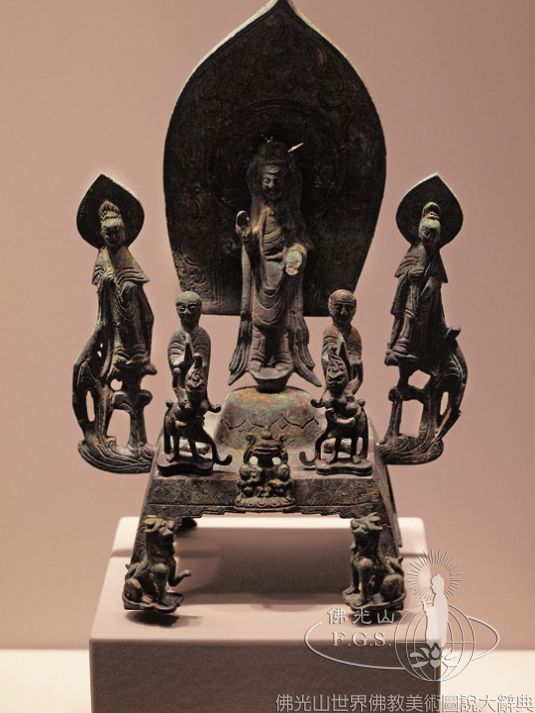
Avalokitesvara Bodhisattva and Attendants
|
| |
|
Avalokitesvara Bodhisattva and Attendants
CHINA; Sui dynasty (581–618), dated 599; Commissioned by Lady Wangjia; Gilt bronze; H: 22 cm; Nelson–Atkins Museum of Art, Kansas City, Missouri, USA
Buddhist artwork during the Sui dynasty (581-618) was a combination of styles from the Northern Zhou (557-581) and Southern Dynasties (420-589). The bodies became slimmer as more emphasis was placed on the mandorla and stands. The main Bodhisattva in this piece is accompanied by a variety of figures. Avalokitesvara's right and left hands make the abhaya (fearlessness) and varada (wish-granting) mudras. The figure is similar in appearance to a Buddha apart for the topknot with its descending stole. The nimbus is circular and contained within a petal shaped mandorla with a decorative outer border.
Two attendant Bodhisattvas stand on lotuses that sprout from either side of the four-legged base. A petal-shaped nimbus backs the Bodhisattvas. Two disciples are located on either side of the central figure, with hands in reverence and standing behind two warriors with hair that twists to a peak. Lions at the bottom gaze toward a mountain censer. An inscription on the statue states it was dedicated in 599 by a woman named Wangjia for her children and deceased father. |