 |
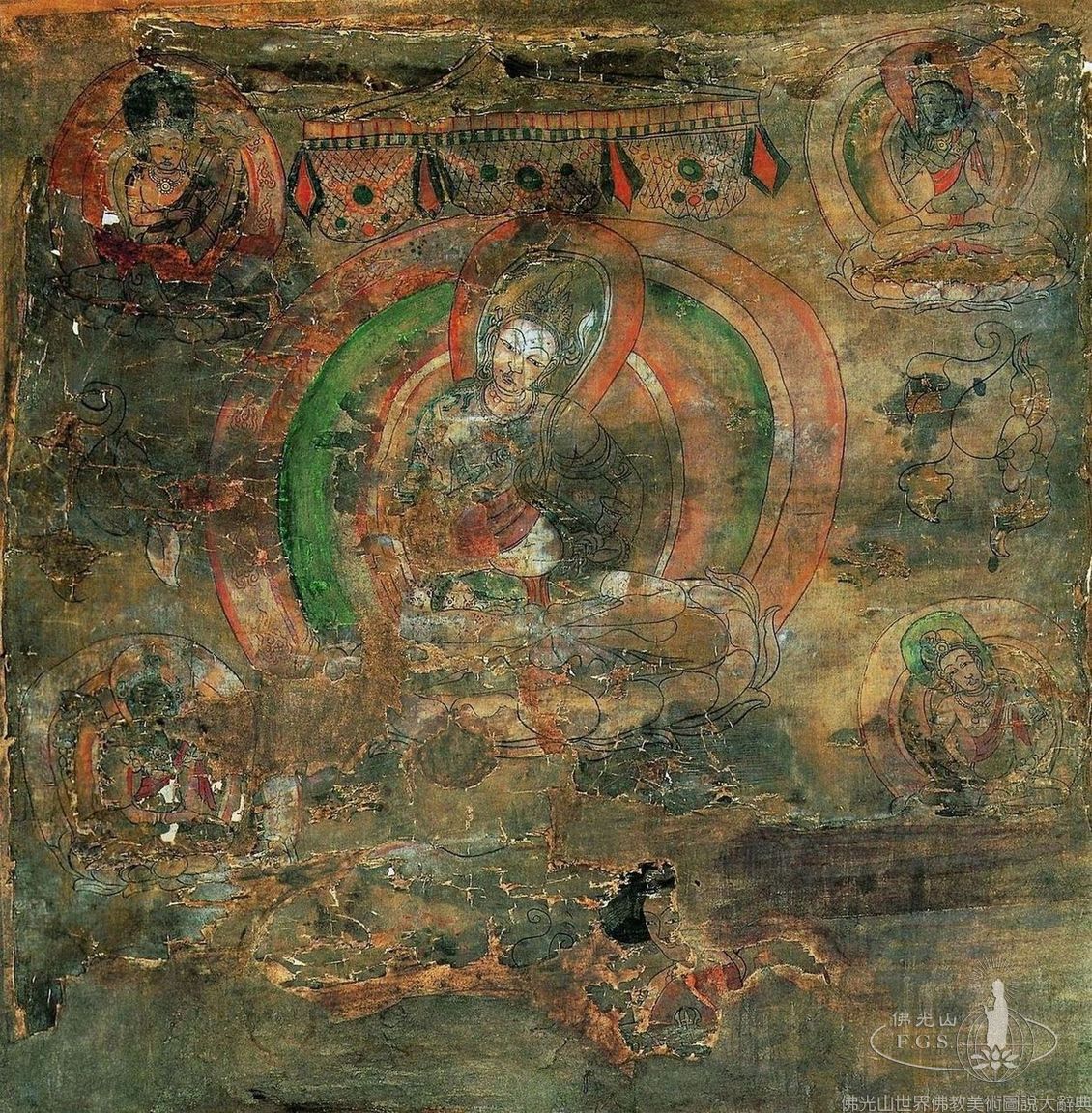
Mogao Cave 17: Vajrasattva Mandala
|
| |
|
Mogao Cave 17: Vajrasattva Mandala
CHINA, Gansu, Dunhuang; Tang dynasty (618–907); Ink and color on silk; 64 x 62.3 cm; Guimet Museum of Asian Art, Paris, France
Vajrasattva Bodhisattva is known for his vow to overcome all negative karmas. In this mandala found in Mogao Cave 17, the white-bodied Vajrasattva sits in full lotus position on a lotus throne, tilting the head to one side. The Bodhisattva wears a headdress and is sheltered by a canopy. A petal-shaped nimbus and a quickly painted aureole surround the figure. The right hand holds a vajra and the left hand holds a bell facing upwards. The description of Vajrasattva in the Adhyardhasatika Prajnaparamita states that the bell should face downward; although in most images of Vajrasattva found in Tibet and Nepal, the bell tends to face upward.
There is a Bodhisattva in each of the four corners. Vajragiti and Vajramala are in the upper corners; Vajranrti and Vajralasi occupy the lower corners. The damaged female figure partially visible in the center of the lower register is thought to be the donor of the painting. |