 |
White Tara
|
| |
|
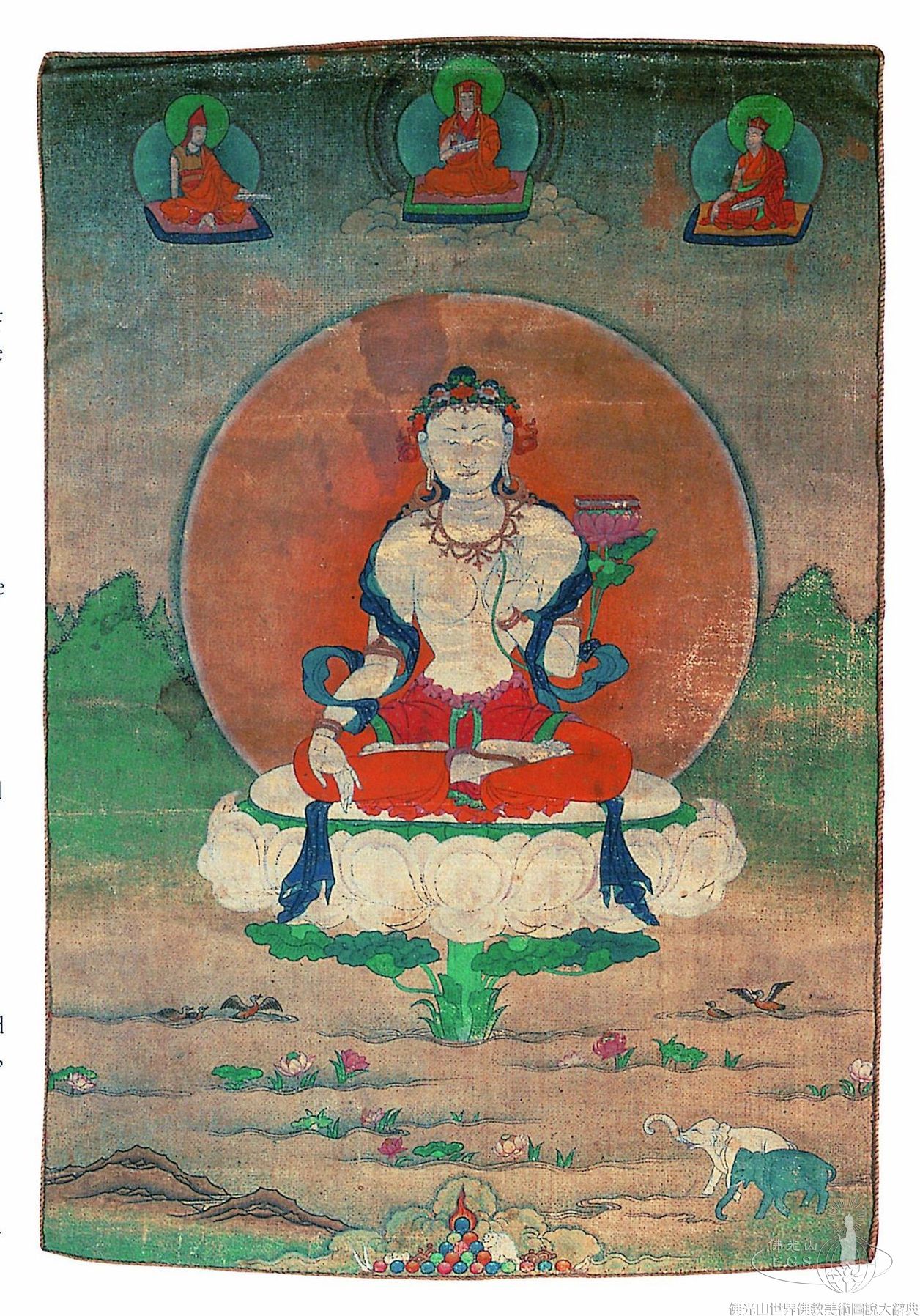
White Tara
CHINA, Tibet; 17th century; Color on cotton; 36 x 24 cm; American Museum of Natural History, New York, USA
This early 17th century thangka originated from eastern Tibet. White Tara sits in full lotus position on a white lotus. The right hand is lowered, forming the varada (wish-granting) mudra. The raised left hand holds the stem of a lotus flower that supports a scroll. Tara has broad shoulders and a slim waist. A crown of flowers surrounds the topknot. Golden ornaments adorn the body. A blue stole is wrapped around the shoulders and hangs down over the front of the lotus. The lower body is covered by an orange dhoti. The large mandorla behind the body resembles the rising sun. This figure does not have the eyes on the forehead, palms, and soles of the feet shown in many other depictions of White Tara. Unlike many other thangka paintings, the background is sparse. Elephants, flaming jewels, and flowers are painted in the lower register. Three lamas sit in the upper register; the Shamarpa of the Karma Kagyu school is in the center. |