 |
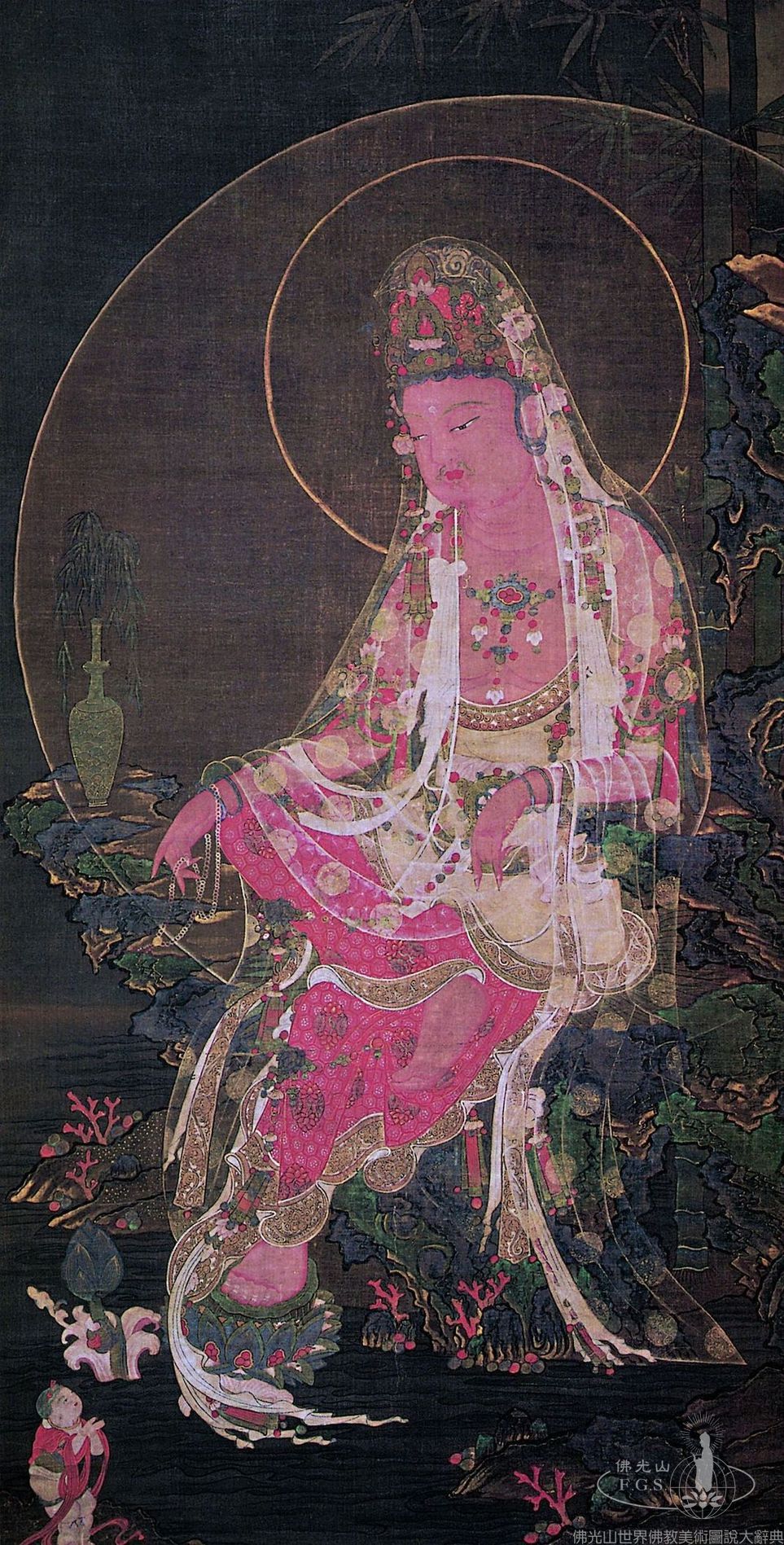
Water-Moon Avalokitesvara
|
| |
|
Water-Moon Avalokitesvara
KOREA; Goryeo dynasty (918–1392); Ink and color on silk; 159.6 x 82.5 cm; Harvard Art Museums, Cambridge, Massachusetts, USA
Paintings of Water-Moon Avalokitesvara Bodhisattva first appeared in China during the Tang dynasty (618-907). They gained popularity during the Five Dynasties (907-960), and became a prominent subject for Buddhist paintings during the Song dynasty (960-1279). The loss of many pre-15th century Korean Buddhist artworks makes it difficult to determine when this form of Avalokitesvara was first painted in Korea. Based on similarities in style between this artwork and Japanese scroll paintings of Avalokitesvara, it is thought to date from the 14th century.
Wearing an elegant transparent stole draped over a headdress adorned with a Buddha image, Avalokitesvara sits on a rock above the sea. A necklace hangs above a beautifully patterned inner garment. The Bodhisattva holds prayer beads in the right hand; the left elbow rests on a rock. A vase containing a willow branch is placed upon a thin outcropping on the left. In the lower left corner, Sudhana looks up at the Bodhisattva and joins his palms. Gold and white highlights on the clothing make Avalokitesvara shine with pale light. The rocks are outlined with thick ink strokes and are filled in with earthy greens, blues, and golds. They contrast interestingly with the brightly colored central figure. |