 |
Reliquary Caskets
|
| |
|
Reliquary Caskets
CHINA; Tang dynasty (618–907); Zhenjiang Museum, Jiangsu, China
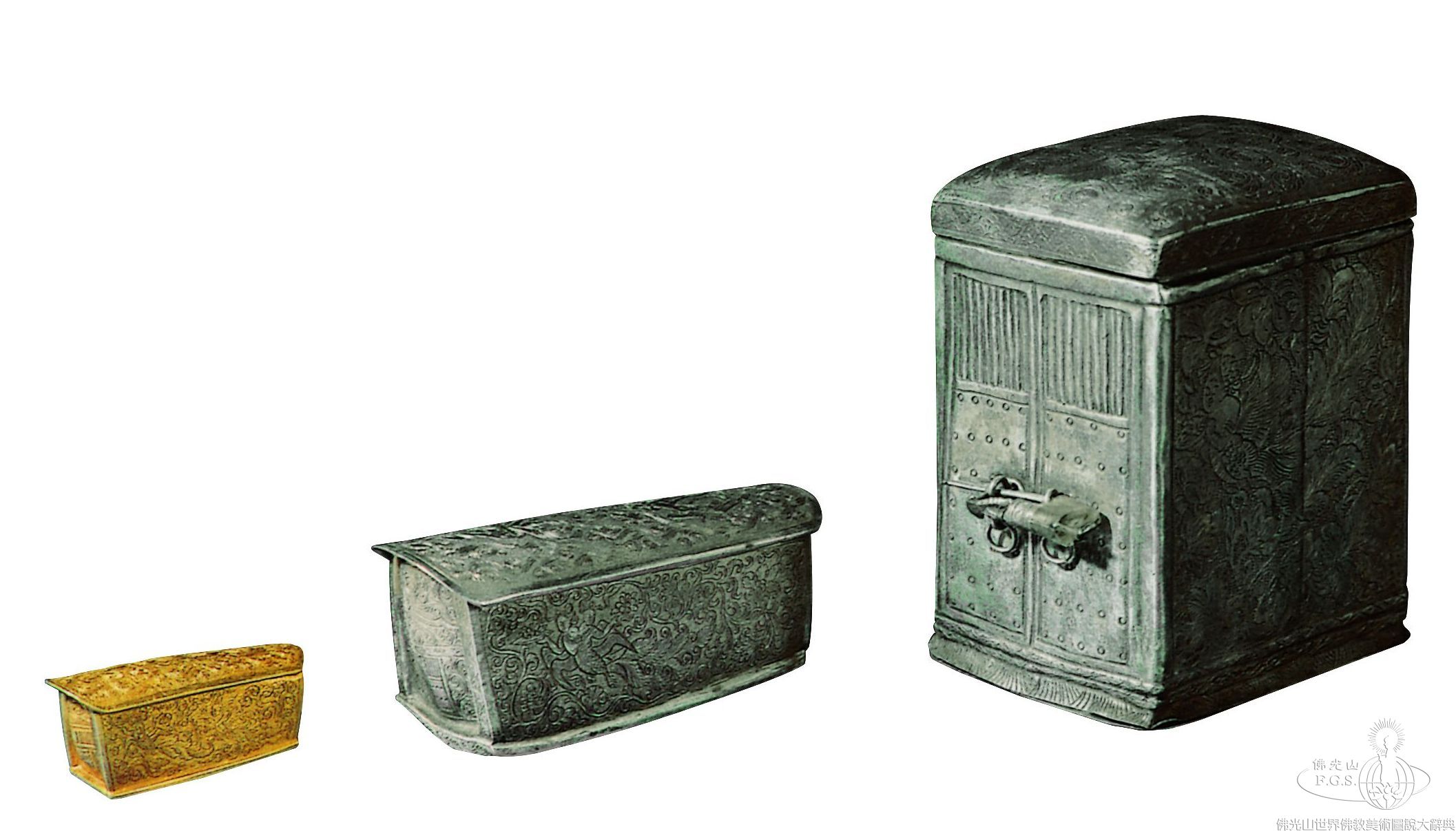
Of these three reliquary caskets, the silver casket was originally placed in Chanzhong Temple in Nanjing, while the inner gold casket and intermediate silver casket were once placed in Changgan Temple. Li Deyu, a Tang dynasty official, buried them together in the underground palace of the Iron Pagoda to pray for the deceased Emperor Muzong (reigned 820-824). They were recovered in 1960.
The silver reliquary casket is square with a pair of cranes and a scroll leaf pattern on the curved lid. At the front, there are doors with imitation doornails, vertical bar windows, and a removable lock. There is a pair of wild geese on the back, and the other two sides each feature a kalavinka surrounded by floral patterns against a stippled background. The three-tier base is decorated with flowering crab apple and scroll leaf patterns.
The intermediate silver casket has exquisite patterning on the exterior. There is a pair of apsaras on the lid surrounded by floating cloud and scroll leaf designs. One end of the casket features a door, scroll leaf pattern, and a jewel, while the other is engraved with a cloud pattern. On the side, there is a double-headed figure with a birds body surrounded by patterns.
The exterior of the gold casket is decorated with rows of flower patterns, and the lid features three cranes soaring in a sea of clouds. There is a pair of two-headed kalavinkas on either side of the casket, inside which there are 11 relics of King Asoka (reigned circa 269-232 BCE). |